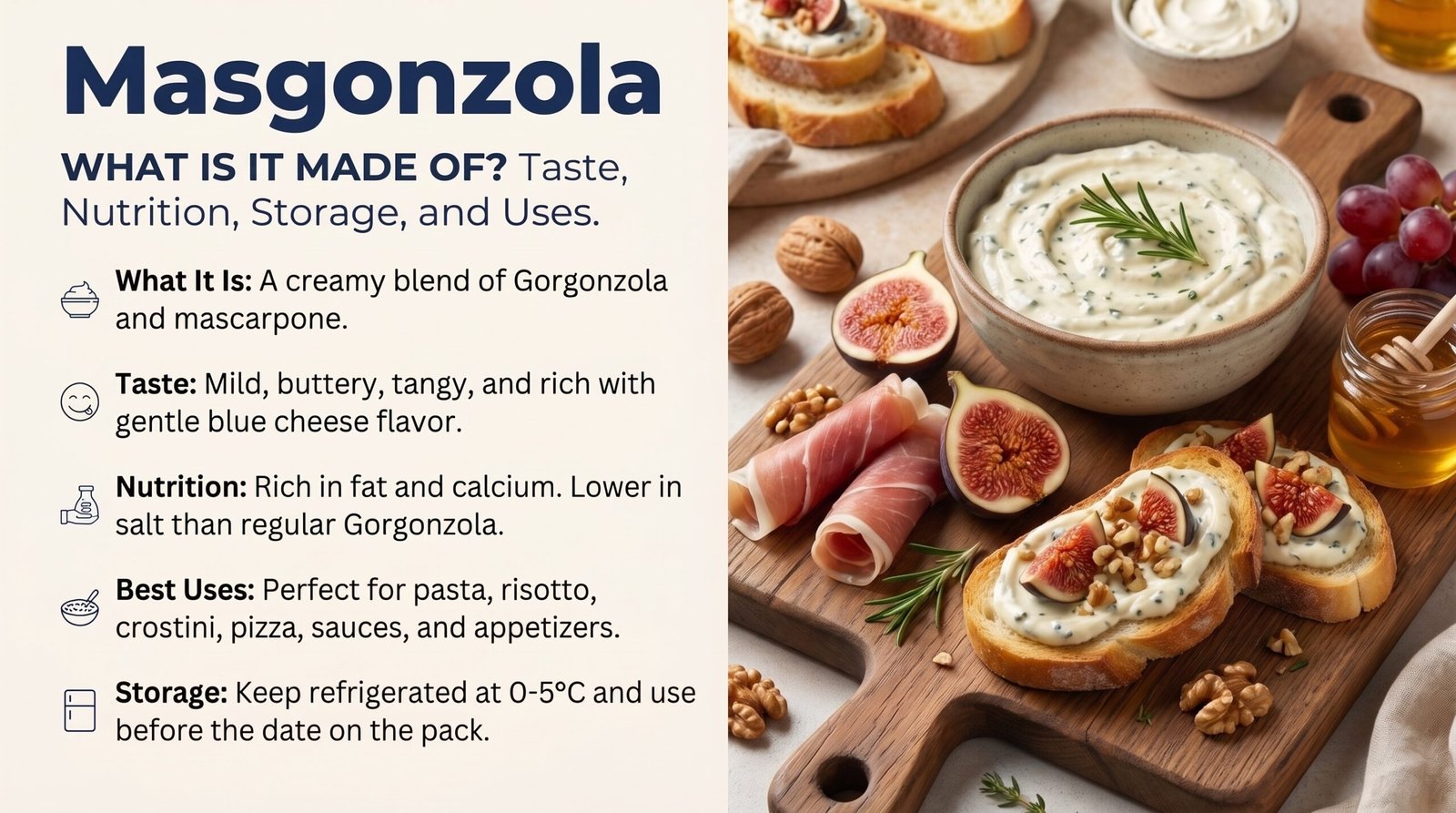
Masgonzola is an unusual food term that can initially sound like the name of a traditional Italian cheese. In practice, the strongest evidence points to Masgonzola as a combination of Gorgonzola and mascarpone, bringing together the distinctive blue-cheese character of Gorgonzola with the soft, rich, creamy texture of mascarpone. The name itself appears to combine parts of the two words, making it a convenient name for this particular cheese preparation.
The distinction is important because Gorgonzola has a long documented history and protected designation status, while Masgonzola does not have the same independently protected identity. Recipe usage provides particularly useful evidence: Masgonzola has been used as a shorthand for a mixture of Gorgonzola and mascarpone, including in risotto recipes where it can replace the two ingredients separately.
Masgonzola is therefore best understood as a creamy Gorgonzola-mascarpone specialty rather than an ancient cheese with its own standardized production tradition. Its appeal comes from the balance between two very different dairy products: one bold and blue-veined, the other mild, smooth, and rich.
Quick Information Table
| Detail | Information |
|---|---|
| Name | Masgonzola |
| Main ingredients | Gorgonzola and mascarpone |
| Type | Creamy cheese combination or specialty |
| Main flavor | Tangy, savory, buttery, creamy, and mildly salty |
| Texture | Soft, rich, creamy, and often spreadable |
| Main purpose | Softening the intensity of blue cheese while retaining its character |
| Related cheese | Gorgonzola |
| Separate protected designation | No separate verified Masgonzola PDO |
| Common forms | Blended or layered |
| Common uses | Risotto, pasta, sauces, pizza, bread, crostini, appetizers, and cheese boards |
| Main allergen | Milk |
| Storage | Refrigerated |
| Key distinction | It combines two established ingredients rather than being the same thing as Gorgonzola |
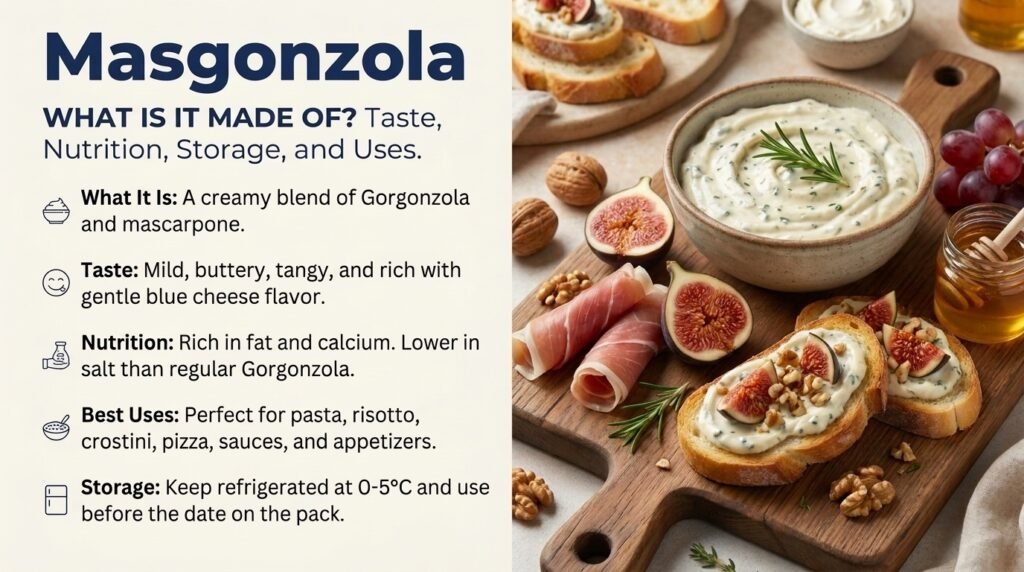
What Is Masgonzola?
Masgonzola generally refers to a preparation made from Gorgonzola and mascarpone.
The two ingredients contribute very different qualities. Gorgonzola is a blue-veined Italian cheese with a recognizable savory, tangy and sometimes pungent character. Mascarpone, on the other hand, is exceptionally soft and creamy with a mild, rich flavor.
When combined, the result is considerably different from eating Gorgonzola alone. The mascarpone adds richness and smoothness, while the Gorgonzola supplies the stronger flavor and blue-cheese character.
This makes Masgonzola useful for people who enjoy blue cheese but prefer a softer and more approachable texture.
Recipe evidence also supports this interpretation. A risotto recipe using Gorgonzola and mascarpone separately specifically suggests replacing both ingredients with Masgonzola, showing that the term is used as a practical name for the combined preparation.
Where Does the Name Masgonzola Come From?
The name is most naturally understood as a blend of “mascarpone” and “Gorgonzola.”
The first part resembles mascarpone, while the latter part comes from Gorgonzola. This type of word formation is often used for food combinations because it immediately gives consumers an idea of what ingredients are involved.
It also explains why Masgonzola can sound like an independent Italian cheese even though the evidence does not establish it as a separate protected cheese category.
This distinction is especially useful when researching unfamiliar food terms online. A memorable name can become widely repeated even when it is essentially a shorthand description of an existing combination.
The Two Main Ingredients
Understanding Masgonzola starts with understanding the two cheeses that form it.
Gorgonzola
Gorgonzola is a traditional Italian blue-veined cheese associated with areas of Lombardy and Piedmont. Its production is regulated under the European protected designation system, and the official protection framework establishes specific requirements for authentic Gorgonzola.
The cheese has a long history. The official protection consortium traces its origins back many centuries and describes Gorgonzola as a traditional Italian blue cheese produced within defined territories. Its designation of origin was formally recognized in Italy in 1955, while the protection system has subsequently been reinforced through European rules.
Gorgonzola is known for:
- Blue-green veining
- Creamy or semi-soft texture
- Tangy flavor
- Savory and salty notes
- Distinctive aroma
- Different levels of intensity depending on the style and maturation
It can be eaten on its own or incorporated into pasta, risotto, pizza, sauces, appetizers and other dishes.
Mascarpone
Mascarpone provides almost the opposite sensory experience.
It is extremely creamy, rich and mild, making it popular in both sweet and savory recipes. Its smooth texture is particularly valuable when combined with stronger ingredients.
In Masgonzola, mascarpone acts as the creamy component. It can soften the sharper characteristics of Gorgonzola while making the final preparation easier to spread and incorporate into sauces.
How Masgonzola Is Made
There is no single universally established Masgonzola production method comparable to the regulated production requirements for Gorgonzola PDO.
Instead, the combination can be prepared by bringing together prepared Gorgonzola and mascarpone.
Depending on the product or recipe, the two components may be:
- Thoroughly blended together
- Combined while retaining some textural differences
- Arranged in visible layers
- Used together directly in cooking
Some commercial examples are described as using equal proportions of Gorgonzola and mascarpone, but there is no universal ratio that defines every product called Masgonzola. This means that one version can taste noticeably stronger than another depending on the proportion of blue cheese used.
Blended Versus Layered Versions
A blended preparation tends to provide a more consistent texture and flavor in every bite.
A layered version can create a more noticeable contrast. The creamy mascarpone and blue-veined Gorgonzola remain visually and texturally distinguishable, allowing the eater to experience both components separately.
Neither approach should automatically be considered the definitive version because Masgonzola does not have one universally recognized production standard.
What Does Masgonzola Taste Like?
The flavor of Masgonzola depends largely on the balance between Gorgonzola and mascarpone.
The Gorgonzola contributes:
- Tanginess
- Saltiness
- Earthy notes
- Blue-cheese character
- A stronger savory aroma
The mascarpone contributes:
- Creaminess
- Mild sweetness
- Richness
- Smooth mouthfeel
- A softer overall character
Together, they create a flavor profile that can be described as creamy, buttery, savory, tangy and mildly blue-cheesy.
Compared with plain Gorgonzola, Masgonzola will generally seem softer and less aggressive because the mascarpone dilutes the intensity of the blue cheese.
However, it should not be assumed that every Masgonzola product tastes the same. A preparation containing a larger proportion of Gorgonzola will naturally have a stronger blue-cheese character.
Masgonzola Compared With Gorgonzola
Masgonzola and Gorgonzola are related but are not the same thing.
| Feature | Masgonzola | Gorgonzola |
|---|---|---|
| Composition | Gorgonzola plus mascarpone | Traditional blue cheese |
| Texture | Very soft and creamy | Creamy to firmer depending on style |
| Flavor | Milder, creamy, tangy | Stronger blue-cheese character |
| Protected designation | No separate verified PDO | Protected Italian PDO |
| Main purpose | Combination and culinary versatility | Standalone cheese and ingredient |
| Production standard | No single universal Masgonzola formula | Regulated production requirements |
| Common use | Spreads, sauces, risotto, pasta | Cheese boards, sauces, risotto, pizza, pasta |
The key difference is that Gorgonzola is an independently recognized and protected cheese, while Masgonzola refers to a combination involving Gorgonzola and mascarpone. The official protection consortium identifies Gorgonzola as a European-recognized PDO product.
Is Masgonzola a Traditional Italian Cheese?
This is one of the most important questions surrounding the term.
Masgonzola should not be presented as though it has the same historical status as Gorgonzola. There is strong evidence for the traditional history and protected identity of Gorgonzola, but the available evidence instead points to Masgonzola being a culinary combination or specialty.
The name appears in recipes as a practical substitute for separate Gorgonzola and mascarpone. That is different from having a legally protected designation with its own geographical production area, production specification and official certification system.
Therefore, describing Masgonzola as a modern cheese combination is more accurate than claiming that it is an ancient independent cheese.
Culinary Uses of Masgonzola
One of Masgonzola’s biggest advantages is its versatility.
Because it combines a strong cheese flavor with a soft, creamy texture, it can be incorporated into many dishes.
Masgonzola in Risotto
Risotto is one of the clearest documented uses.
Gorgonzola and mascarpone can be added separately toward the end of cooking to create a rich, creamy finish. A prepared Masgonzola combination can simplify the process because both components are already together.
It works particularly well with ingredients such as spinach, mushrooms, pears, walnuts and other foods that complement creamy blue-cheese flavors.
Masgonzola in Pasta
Masgonzola can be melted into pasta sauces to create a creamy cheese coating.
Its soft structure makes it suitable for sauces where the goal is to distribute the cheese evenly throughout the dish.
It can also be combined with:
- Cream
- Butter
- Garlic
- Spinach
- Mushrooms
- Walnuts
- Herbs
- Pears
The exact combination depends on the recipe and desired balance.
Masgonzola on Pizza
The creamy texture can make Masgonzola useful as a pizza topping.
Instead of relying exclusively on strong blue cheese, the mascarpone component provides additional richness while the Gorgonzola supplies a distinctive savory flavor.
It can be paired with sweet ingredients such as pear or fig, or with vegetables and cured meats.
Masgonzola on Bread and Crostini
Because it is soft, Masgonzola can work particularly well as a spread.
It can be served on:
- Toasted bread
- Crackers
- Crostini
- Flatbreads
- Savory pastries
Sweet accompaniments such as honey, figs or pears can provide a useful contrast to its salty and tangy notes.
Masgonzola on a Cheese Board
Masgonzola can also be used as a component of a cheese board.
Its combination of creamy texture and blue-cheese flavor gives it a different role from harder cheeses.
Potential accompaniments include:
- Pears
- Figs
- Grapes
- Apples
- Walnuts
- Almonds
- Honey
- Fig preserves
- Crackers
- Rustic bread
The sweetness of fruit or honey can balance the salty and tangy qualities of the Gorgonzola component.
Nutrition and Dietary Considerations
The nutritional profile of Masgonzola depends on the specific proportions and products used.
Because mascarpone is rich and Gorgonzola is also a calorie-dense dairy product, Masgonzola should generally be viewed as a rich food rather than a low-calorie ingredient.
The exact values can vary considerably according to:
- Gorgonzola-to-mascarpone ratio
- Brand or producer
- Serving size
- Preparation method
- Additional ingredients
For accurate nutritional information, consumers should rely on the nutrition label of the specific product they purchase.
Milk Allergy
Both major ingredients are dairy products, so Masgonzola is not suitable for people with a milk allergy unless a medically appropriate alternative has been specifically formulated.
People following restricted diets should also check the individual product’s ingredient and allergen information rather than assuming every version has identical ingredients.
How to Store Masgonzola
Masgonzola should be treated as a refrigerated dairy product.
Keep it properly chilled and follow the storage instructions provided by the producer or retailer.
Because the exact formulation can vary, there is no single universal shelf-life rule for every Masgonzola product.
After opening, it is sensible to protect the cheese from excessive exposure to air and moisture and to use it within the period recommended on the packaging.
If the product develops unusual discoloration, an unexpected odor, visible spoilage or an altered texture beyond what is normal for the cheese, it should not be consumed.
How to Buy Masgonzola
One reason Masgonzola can be difficult to find by name is that retailers may use different descriptions.
Instead of searching only for Masgonzola, consumers may encounter names such as:
- Gorgonzola and mascarpone
- Gorgonzola with mascarpone
- Gorgonzola e mascarpone
- Mascarpone-Gorgonzola
- Gorgonzola mascarpone cheese
Checking the ingredient list is more reliable than relying solely on the product name.
If the product contains both Gorgonzola and mascarpone, it is consistent with the culinary meaning commonly associated with Masgonzola.
Why the Term Masgonzola Creates Confusion Online
The unusual name has encouraged different descriptions across the internet.
Some pages treat Masgonzola as a food combination, while others have presented it more vaguely as a coined or emerging term. The strongest food-specific evidence, however, comes from its actual use in recipes as a shorthand for combining Gorgonzola and mascarpone.
This is a useful example of why unfamiliar food terms should be checked against practical evidence rather than relying only on repeated descriptions.
A term appearing on many websites does not automatically mean it represents a formally recognized food category.
The Difference Between a Food Combination and a Protected Cheese
This distinction is central to understanding Masgonzola.
A protected cheese such as Gorgonzola has defined geographical and production requirements. The official protection system exists to protect the name, characteristics and authenticity of the product. The Gorgonzola consortium specifically describes its role as protecting production, trade and the proper use of the PDO name.
Masgonzola does not have an equivalent independently verified PDO identity.
That does not make the combination meaningless. It simply means the term should be used accurately.
A food can be a legitimate culinary combination without being a protected geographical designation.
Latest Context Around Masgonzola
As of 2026, the most reliable understanding of Masgonzola remains its association with Gorgonzola and mascarpone rather than a newly established protected cheese category.
Gorgonzola itself continues to have an active production and promotional industry. Its official consortium reported international promotional activity in 2026, including participation in major food trade events in Tokyo, Milan, New York and Paris.
This ongoing activity demonstrates that the underlying Gorgonzola component remains an important part of Italian food culture.
Masgonzola, meanwhile, is better understood through its culinary use: a convenient combination that brings together the intensity of Gorgonzola and the richness of mascarpone.
Frequently Asked Questions About Masgonzola
Is Masgonzola the same as Gorgonzola?
No. Masgonzola generally refers to a combination of Gorgonzola and mascarpone, while Gorgonzola is an established Italian blue cheese with protected designation status.
What is Masgonzola made from?
The principal ingredients are Gorgonzola and mascarpone.
Is Masgonzola a protected cheese?
There is no separate verified Masgonzola PDO comparable to Gorgonzola PDO.
Does Masgonzola taste strong?
It can have a noticeable blue-cheese flavor, but the mascarpone generally makes it creamier and softer than Gorgonzola by itself.
Can Masgonzola be used in risotto?
Yes. Recipe evidence specifically uses Masgonzola as a substitute for separate Gorgonzola and mascarpone in risotto.
Can Masgonzola be spread on bread?
Yes. Its soft, creamy structure makes it suitable for bread, crackers and crostini.
Is Masgonzola always made with the same ratio?
No. There is no universal formula requiring one fixed ratio of Gorgonzola to mascarpone.
Final Thoughts on Masgonzola
Masgonzola is best understood as a Gorgonzola-and-mascarpone cheese combination rather than as a separate ancient cheese with its own protected designation.
Its appeal comes from the contrast between the two ingredients. Gorgonzola contributes blue-cheese intensity, tanginess and savory depth, while mascarpone brings softness, richness and creaminess. The combination can therefore be used in dishes where traditional Gorgonzola might be considered too strong or where a smoother cheese texture is desirable.
The name itself is a useful culinary shorthand, but it should not be confused with the protected identity and long documented history of Gorgonzola. Understanding this distinction makes it easier to evaluate Masgonzola accurately and recognize why it works particularly well in risotto, pasta, sauces, pizza, spreads and cheese boards.