
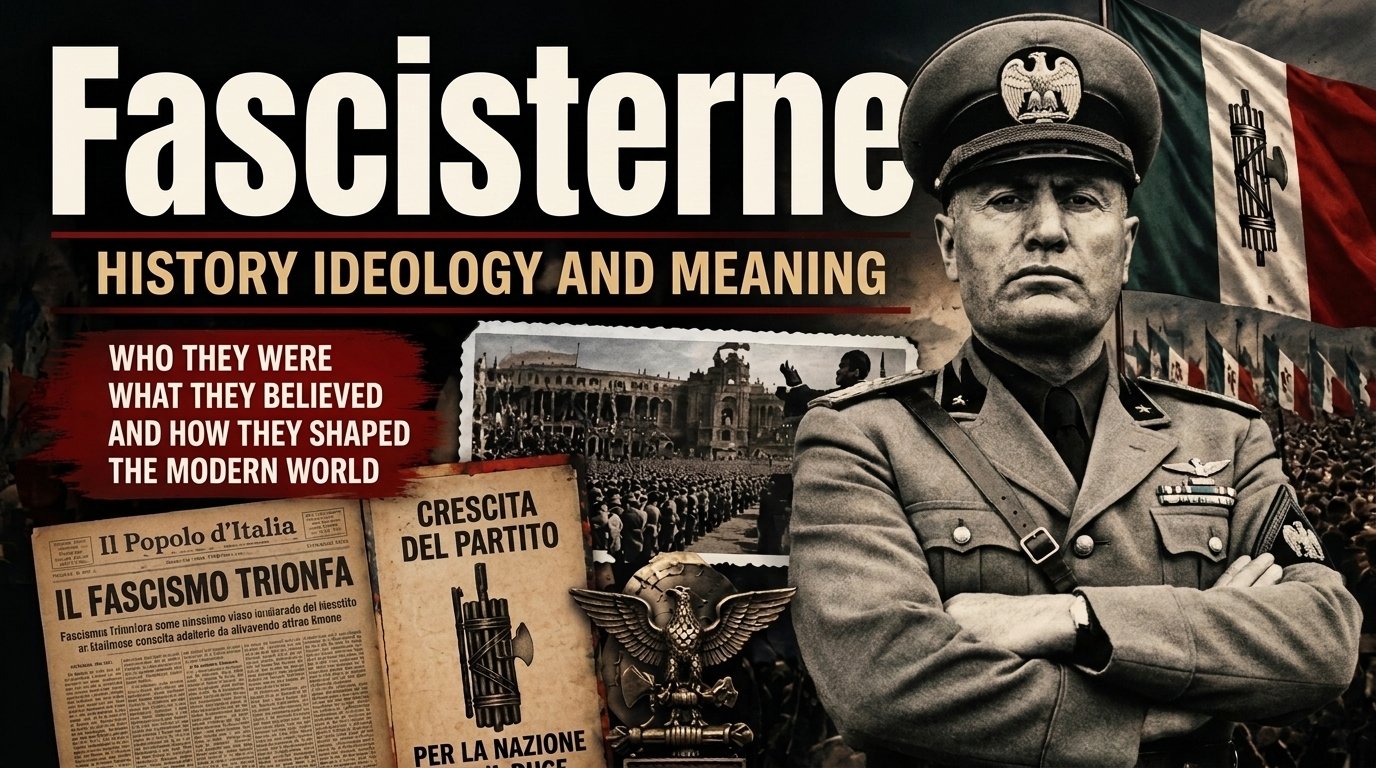
The word Fascisterne is Danish and translates most directly into English as “the fascists.” It is the definite plural form of the Danish word fascist, so it refers to a group of people associated with fascism rather than to fascism itself. The exact people being described depends on the historical or political context in which the word appears.
Although the word itself is simple to translate, understanding Fascisterne requires some knowledge of the history of fascism. Fascism became a major political force in Europe after the First World War, particularly through the movement led by Benito Mussolini in Italy. Related movements later appeared in several European countries, including Denmark, where the Danish National Socialist Workers’ Party became an important example of a domestic Nazi movement during the 1930s and the German occupation.
Quick Information About Fascisterne
| Detail | Information |
|---|---|
| Word | Fascisterne |
| Language | Danish |
| English meaning | The fascists |
| Singular | Fascist |
| Indefinite plural | Fascister |
| Definite plural | Fascisterne |
| Related concept | Fascism |
| Origin of modern fascism | Italy, early 20th century |
| Major historical figure | Benito Mussolini |
| Danish historical connection | Fascist and Nazi movements of the 1930s and 1940s |
| Major Danish Nazi party | Danmarks Nationalsocialistiske Arbejderparti (DNSAP) |
| DNSAP founded | November 16, 1930 |
| Important Danish leader | Frits Clausen |
| German occupation of Denmark | 1940–1945 |
| DNSAP electoral result in 1939 | 1.8%, 3 seats |
| DNSAP electoral result in 1943 | About 2.1%, 3 seats |
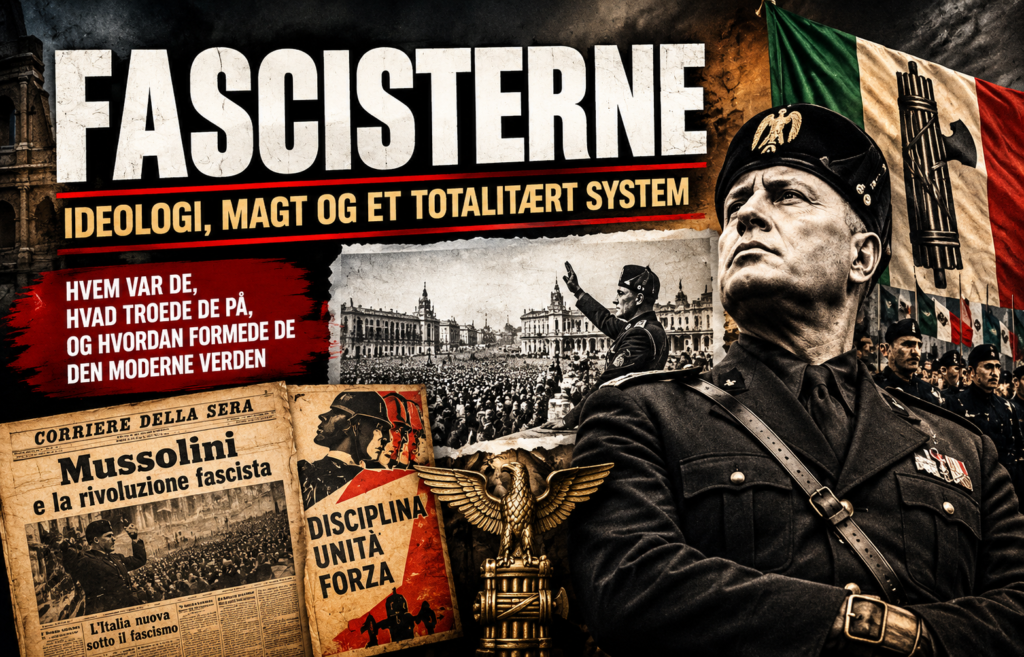
What Does Fascisterne Mean?
Fascisterne literally means “the fascists” in Danish. It is not the name of one particular organization, political party, or historical movement.
The Danish word can be understood by looking at its grammatical forms:
- Fascist = a fascist
- Fascisten = the fascist
- Fascister = fascists
- Fascisterne = the fascists
This distinction is important because the word identifies people rather than the ideology itself. In Danish, fascisme is the word used for fascism as a political ideology.
Therefore, a historical sentence mentioning fascisterne might refer to Italian fascists, Danish fascists, German-associated fascists, or another group that the writer has already identified as fascist.
Why Context Is Important
The word does not automatically identify a particular political organization. For example, a Danish historical text discussing Italy in the 1920s could use fascisterne to describe supporters of Mussolini. A text about Denmark during the Second World War could use the same word when discussing Danish fascist or Nazi movements.
This is why translating the word without considering the surrounding text can sometimes produce an incomplete understanding.
Where Did Fascism Come From?
Modern fascism is most strongly associated with Italy after the First World War. The movement developed during a period of political instability, social conflict, economic difficulties, and dissatisfaction with existing political institutions.
Benito Mussolini became the central figure in the development of Italian fascism. In 1919, he established the first organized Italian Fascist movement. The movement later developed into the National Fascist Party.
The term fascism is connected to the Italian fascio and ultimately to the Latin fasces, an ancient Roman symbol consisting of bundled rods associated with authority. Mussolini adopted the symbolism as part of his political movement.
Fascist movements generally emphasized powerful centralized government, intense nationalism, political discipline, and hostility toward liberal democracy and socialism. However, fascism was not identical in every country. Different movements adapted fascist ideas to their own national circumstances.
Mussolini and the Rise of Italian Fascism
The development of Italian fascism provides the most important historical background for understanding Fascisterne.
Mussolini’s movement gained support during the difficult years following the First World War. Fascist groups used political organization, propaganda, nationalist rhetoric, and violence against opponents to expand their influence.
A decisive moment came in October 1922 with the March on Rome. Thousands of armed Fascists participated in the demonstration and pressure campaign. Rather than ordering a military confrontation, King Victor Emmanuel III invited Mussolini to form a government. Mussolini therefore entered the office of prime minister through existing constitutional arrangements, although his government subsequently dismantled democratic constraints and developed into a dictatorship.
This history is important because fascist regimes did not necessarily appear overnight as fully established dictatorships. In Italy, political institutions were initially used as part of the process through which Mussolini consolidated power.
Main Characteristics Associated With Fascism
Historical fascist movements differed from one another, but scholars commonly identify several recurring characteristics.
Extreme Nationalism
Fascist politics generally placed the nation above individual interests. National unity and national strength were presented as essential political goals.
Opposition to Liberal Democracy
Historical fascist movements generally rejected liberal democratic institutions, political pluralism, and the idea that competing parties should peacefully alternate in government.
Authoritarian Leadership
Fascist movements frequently emphasized a powerful leader and a highly centralized political structure. The leader was often presented as a symbol of national unity and authority.
Political Repression
Fascist governments and movements used intimidation, censorship, violence, imprisonment, and restrictions on political opponents. The level and methods of repression varied between countries.
Propaganda and Mass Mobilization
Propaganda was an important tool. Fascist movements used newspapers, speeches, symbols, public demonstrations, youth organizations, and other forms of communication to build political support and shape public opinion.
Anti-Socialism and Anti-Communism
Fascist movements strongly opposed socialism and communism. In several countries, fascist organizations used violence against socialist and communist activists.
These characteristics help explain why the word fascisterne carries a much more specific historical meaning than simply describing people who support a strong government or nationalism.
Fascisterne and Denmark
The term has a particularly interesting connection with Danish history.
Denmark did not become a fascist dictatorship comparable to Mussolini’s Italy or Hitler’s Germany. Nevertheless, fascist and National Socialist movements existed in Danish political life during the interwar period.
The most significant organization was the Danmarks Nationalsocialistiske Arbejderparti, commonly abbreviated as DNSAP. It was founded on November 16, 1930, by Cay Lembcke. The organization was strongly influenced by the German Nazi movement and adopted many of its political and organizational characteristics.
DNSAP used nationalist and authoritarian ideas and incorporated racial ideology and antisemitism into its program. Its organizational structure and symbolism were also strongly influenced by the German Nazi Party.
Frits Clausen and DNSAP
Cay Lembcke was the original leader of DNSAP, but the party’s most prominent leader became Frits Clausen.
Clausen took control of the party in 1933. Under his leadership, DNSAP became more organized and expanded its activities, although it remained a relatively small political force compared with Denmark’s established democratic parties.
The party’s political position was complicated by its combination of Danish nationalism and close ideological imitation of Nazi Germany. This created a significant contradiction: DNSAP presented itself as a nationalist Danish movement while simultaneously looking to Germany as its principal ideological model. Historical research identifies this tension as one of the reasons the party struggled to gain broader support.
DNSAP in the 1939 Election
DNSAP eventually achieved representation in the Danish parliament.
In the 1939 parliamentary election, the party received approximately 1.8% of the vote and won three seats in the Folketing. This was the first time DNSAP gained parliamentary representation.
The result was historically significant for the party, but it also demonstrates how limited its electoral support remained. Despite years of organization and political campaigning, DNSAP did not become a major governing party.
Denmark Under German Occupation
Germany invaded Denmark on April 9, 1940, beginning an occupation that lasted until 1945.
DNSAP supported the German occupation and hoped that the political situation would eventually allow the party to take control of Denmark. However, those ambitions were not realized.
The German authorities generally continued working with the existing Danish government rather than replacing it with a DNSAP government. Frits Clausen’s attempts to obtain political power with German assistance therefore failed.
This is an important distinction when studying Fascisterne in the Danish context: the existence of a Danish Nazi organization did not mean Denmark itself became a fascist state.
The 1943 Election
DNSAP contested another parliamentary election in March 1943.
The party received approximately 43,000 votes, around 2.1%, and again won only three seats. Despite the difficult political conditions created by the occupation and the party’s increased organizational activity, it did not achieve the breakthrough its leaders had hoped for.
Historical sources describe the result as a major disappointment for DNSAP. Its inability to achieve broad electoral support remained one of the central features of its history.
Membership Versus Electoral Support
One interesting feature of DNSAP was the difference between membership numbers and electoral support.
The party’s membership increased substantially during the occupation period. Historical records indicate that membership reached approximately 21,500 in 1943, while the party received only around 43,000 votes in the parliamentary election that year.
This does not mean that every member necessarily voted for the party in the same way, but it illustrates that organizational membership and electoral success were not identical.
The party could maintain a committed activist base without becoming a mass electoral movement.
Frits Clausen During the Occupation
Frits Clausen continued trying to strengthen his political position during the occupation.
He hoped German support could help DNSAP obtain government power, but German authorities ultimately did not install him as leader of the Danish government. The existing Danish political structure was considered more useful to the occupation authorities for maintaining order and cooperation.
In 1943, after DNSAP’s disappointing election result, Clausen’s political position weakened further. He eventually volunteered as a military doctor with the Waffen-SS.
The End of DNSAP
The German occupation ended in May 1945.
After the liberation of Denmark, DNSAP was dissolved. Clausen and other leading figures faced arrest and legal consequences connected with collaboration with Nazi Germany.
The party therefore did not survive the end of the Second World War as a major political organization.
Its history nevertheless remains part of Denmark’s political and wartime history because it illustrates how Nazi and fascist ideas spread beyond Germany and Italy and how small domestic movements interacted with a powerful occupying regime.
Fascism and Nazism: Are They the Same?
Fascism and Nazism are closely related but should not simply be treated as identical terms.
Italian fascism under Mussolini and German National Socialism under Adolf Hitler shared several features, including authoritarian leadership, intense nationalism, rejection of liberal democracy, political repression, and mass political mobilization.
However, Nazi ideology placed racial ideology and antisemitism at an especially central position. German Nazism developed its own distinctive worldview and policies, including the systematic persecution and murder of Jews and other groups.
For this reason, historical analysis generally treats Nazism as a related but distinct form of fascist politics rather than simply using the two words as perfect synonyms.
Why Fascisterne Can Mean Different Groups
Because Fascisterne means “the fascists” rather than naming a specific organization, its reference changes according to context.
It may refer to:
- Supporters of Mussolini’s Italian fascism
- Members of a historical fascist movement
- Danish fascist groups
- Danish National Socialists in certain historical discussions
- Fascist organizations in other European countries
- A broader group described as fascist in a particular political or historical text
The surrounding sentence is therefore essential for determining exactly whom the writer means.
Modern Use of the Word Fascisterne
Today, Fascisterne can still appear in Danish historical writing, discussions of the Second World War, political commentary, and translations.
Its historical meaning remains more precise than some modern casual uses of the word “fascist.” In contemporary political arguments, the label is sometimes used very broadly as an accusation against authoritarian or nationalist political opponents. Such usage can differ significantly from the way historians define historical fascist movements.
A careful interpretation should therefore distinguish between a documented historical description and a modern rhetorical use.
Why the History of Fascisterne Matters
The history associated with Fascisterne is important because it demonstrates how political movements can develop during periods of social and economic uncertainty.
Studying fascism also helps explain several major developments of twentieth-century Europe:
- The decline of democratic institutions in some countries
- The growth of authoritarian political movements
- The role of propaganda in political mobilization
- The use of political violence
- The relationship between nationalism and authoritarianism
- Collaboration during military occupation
- The consequences of political persecution
- The development of resistance movements
- The transformation of European politics after the Second World War
The Danish experience is especially useful because Denmark had a domestic Nazi movement without becoming a Nazi dictatorship. DNSAP’s limited electoral success demonstrates that the existence of a fascist or Nazi movement does not automatically mean that such a movement becomes the governing authority.
Fascisterne in Historical Perspective
The simplest definition of Fascisterne is “the fascists,” but the historical meaning is much broader than a dictionary translation.
The word belongs to the Danish language and can describe a group of people associated with fascism. Fascism itself developed as a major political movement in Italy after the First World War and subsequently influenced political organizations throughout Europe.
In Denmark, the most important related organization was DNSAP, founded in 1930 and later led by Frits Clausen. The party adopted many ideas and organizational features from German National Socialism but remained electorally marginal. It gained three parliamentary seats in both 1939 and 1943, despite substantial organizational activity during the German occupation.
The word Fascisterne therefore has both a linguistic meaning and an important historical context. Understanding the distinction between the word, the ideology of fascism, individual movements, and specific historical organizations makes it easier to interpret Danish and European historical material accurately.