
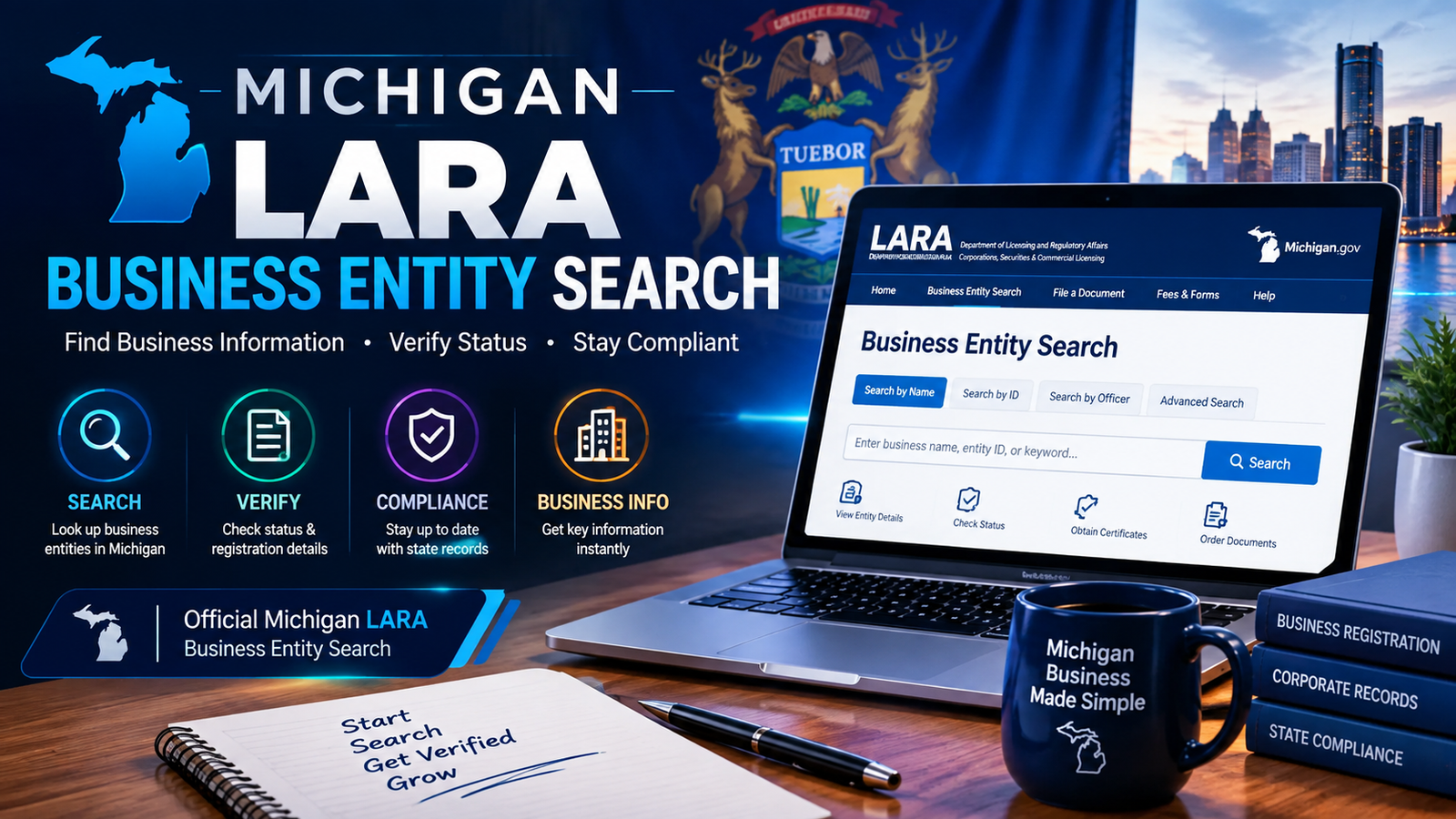
The Michigan LARA Business Entity Search is an online public-record search system used to find information about businesses registered with the State of Michigan. It is particularly useful for checking whether a company exists in Michigan, identifying its entity type and status, reviewing filing history, locating its business identification number, and examining information associated with registered agents and corporate officers.
The search system is administered through the Corporations Division of Michigan’s Department of Licensing and Regulatory Affairs (LARA). Although many people refer to it as a Michigan Secretary of State business search, business-entity filings are actually handled by LARA’s Corporations, Securities & Commercial Licensing Bureau.
The system became significantly more important after Michigan introduced the MiBusiness Registry Portal on June 23, 2025. The new portal brought business searches, online filings, certificates, and copies into a modernized system and replaced the older Corporations Online Filing System for these services.
Quick Information Table
| Feature | Details |
|---|---|
| Official agency | Michigan Department of Licensing and Regulatory Affairs |
| Division | Corporations Division |
| Bureau | Corporations, Securities & Commercial Licensing |
| Search system | MiBusiness Registry Portal |
| Main purpose | Search Michigan business entities and public records |
| Common searches | Business name, filing number, individual name, resident agent and corporation card file |
| Common entities | LLCs, corporations, nonprofit corporations, limited partnerships and LLPs |
| Public search | Available online |
| Business identification | Each registered entity has an identification number |
| Filing records | History and available filings can be reviewed |
| Portal launch | June 23, 2025 |
| Annual LLC filing | Generally due February 15 |
| Annual corporation filing | Generally due May 15 |
| Annual nonprofit filing | Generally due October 1 |
| Main agency role | Business formation, registration records and corporate filings |
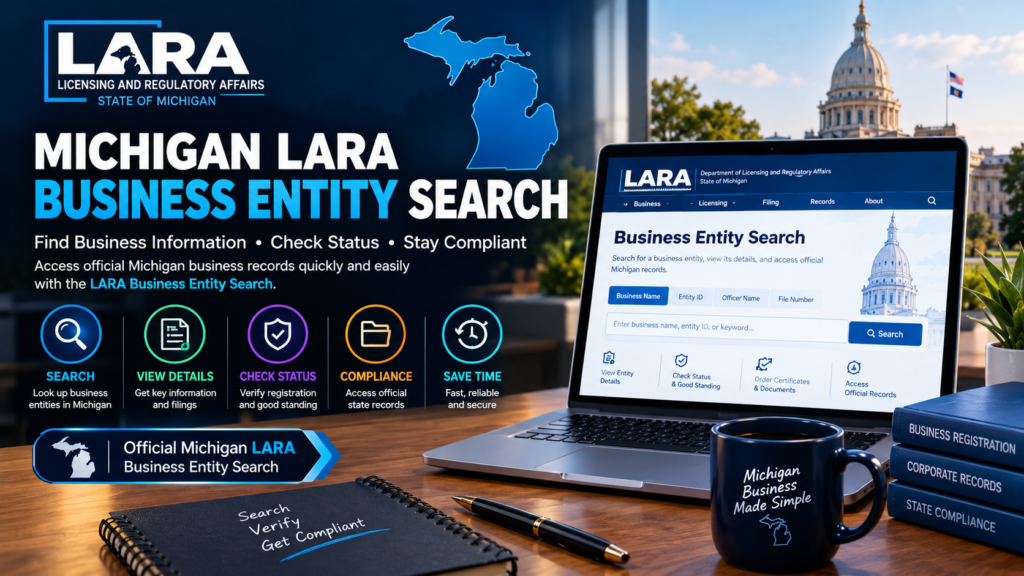
What Is Michigan LARA Business Entity Search?
Michigan LARA Business Entity Search is a public database that allows people to research business entities registered with the state.
The database is useful for entrepreneurs, business owners, attorneys, researchers, lenders, vendors, journalists, government agencies and members of the public who need to verify basic corporate information.
A search can help answer questions such as:
- Does a particular Michigan business exist?
- What type of entity is it?
- Is the entity active?
- What is its Michigan identification number?
- When was the company originally filed?
- Who is listed as its resident agent?
- What registered office is on record?
- When is its next annual filing due?
- Has the business filed annual reports or statements?
- Does the entity have assumed names?
- What historical filings are available?
The Corporations Division maintains records for corporations, limited liability companies, limited partnerships, limited liability partnerships and other business-related registrations under its authority. The division also makes filed business information available to the public.
Who Operates the Michigan Business Entity Search?
One of the most important points to understand is that Michigan’s business-entity registry is associated with LARA, rather than being a business-registration database operated by the Secretary of State.
LARA stands for the Michigan Department of Licensing and Regulatory Affairs. Its Corporations Division is responsible for facilitating the formation of business entities and maintaining corporate records.
The division handles business structures including corporations, LLCs, limited partnerships and limited liability partnerships. It also processes foreign entities seeking authority to conduct business in Michigan.
This distinction matters because people searching online sometimes use the phrase “Michigan Secretary of State business search.” The more precise description for corporate and business-entity records is the Michigan LARA Business Entity Search.
The New MiBusiness Registry Portal
Launch in 2025
Michigan introduced the new MiBusiness Registry Portal on June 23, 2025.
The new system allows users to perform business searches, submit filings online and request certificates and copies. LARA also announced that annual reports and annual statements must be submitted online through the new system rather than through paper filing.
This was an important modernization of Michigan’s business-record infrastructure.
Before the new portal, users commonly encountered the older Corporations Online Filing System. The transition to the MiBusiness Registry Portal changed how business owners and researchers interact with Michigan’s corporate records.
Why the change matters
The newer portal brings several business-related activities together instead of requiring users to navigate separate legacy processes.
For someone researching a Michigan company, the search function can be used first to locate an entity. Business owners can then use the same broader system for applicable filings and document-related services.
This makes the registry useful not only as a lookup database but also as part of Michigan’s broader business compliance system.
What Information Can You Find?
The amount of information available depends on the entity and the records associated with it. A typical business record can contain several important fields.
Entity Name
The entity’s legal name is one of the first pieces of information displayed in search results.
This is important because a company’s public-facing brand name may not be identical to its legal entity name.
For example, a business may operate under an assumed name while its registered legal entity has a different name.
Entity Identification Number
Michigan assigns business entities an identification number. This number can be extremely useful when several companies have similar names.
Searching by an identification number can also help avoid accidentally selecting the wrong business.
Entity Type
The record can identify whether the company is an LLC, corporation, nonprofit corporation or another recognized entity type.
Knowing the entity type is important because filing requirements and legal structures differ between organizations.
Entity Status
The search results can provide an entity’s current status.
Status information can help determine whether a company remains active or whether its registration has changed because of dissolution, withdrawal, revocation or another action.
However, a business search should not be treated as a substitute for legal advice. If the status is important for a transaction or legal matter, users should examine the underlying record and, when appropriate, obtain official documentation.
Annual Report Standing
The registry can also provide information concerning annual-report or annual-statement standing.
This can be particularly useful when determining whether a company appears to be maintaining its required state filings.
Resident Agent
A Michigan business generally has a resident agent associated with its state registration.
The resident agent is responsible for receiving certain legal documents, including service of process and other notices permitted or required by law. Michigan requires the resident agent’s registered address to be in Michigan.
Registered Office
The business record can also contain the registered office address associated with the entity.
This should not automatically be interpreted as the company’s primary operating location. A registered office is part of the company’s official state registration information and can serve a specific legal purpose.
Officers and Directors
Depending on the entity type, records can contain officer and director information.
Michigan’s annual filing requirements require applicable corporations to keep information such as officer and director names and addresses current.
Filing History
One of the most useful parts of the search system is the ability to examine available historical filings.
This can help researchers understand how a business registration has changed over time.
Available documents may include formation documents, annual filings and other records submitted to the state.
How to Use Michigan LARA Business Entity Search
Step 1: Search by Business Name
The simplest method is to search using the business’s legal name or a portion of its name.
If you are uncertain about the exact spelling, a broader search can help identify possible matches.
Step 2: Use Advanced Search
Advanced search options provide additional ways to narrow results.
Available search approaches can include:
- Name or filing number
- Individual name
- Resident agent name
- Corporation card file
The system can also provide filters such as “Contains,” “Starts With” and name-availability searches. Additional filters may include entity type, status and registration dates.
Step 3: Review the Results
After running a search, compare the results carefully.
Important fields may include:
- Business name
- Filing date
- Status
- Annual-report standing
- Entity type
- Entity ID
- Resident agent
- Annual-report due date
This information can help distinguish between businesses with similar names.
Step 4: Open the Business Record
Selecting the appropriate entity allows you to view more detailed information.
Depending on the record, you may see information concerning the entity’s jurisdiction, status, identification number, filing dates, registered agent, registered office, officers, directors and assumed names.
Step 5: Review History and Filings
The history and filings section is especially useful when you need more than basic registration information.
Historical records can provide evidence of previous filings and changes associated with an entity.
This can be useful for due diligence, business research and verifying information that may not be visible from the company’s own website.
Can You Search by an Individual’s Name?
Yes. The search system provides an individual-name search option.
This can be useful when you know the name of a person associated with a business but do not know the company’s exact legal name.
Resident-agent searches can similarly help locate entities connected with a particular registered agent.
However, users should interpret search results carefully. A person’s appearance in a business record does not necessarily mean that person owns the company. Their role could be an officer, director, resident agent or another registered position.
Michigan Business Entity Search and Name Availability
Another important use of the system is researching potential business names.
A prospective business owner can search existing records to identify similar names before attempting to register a new company.
The search system includes a name-availability search option.
However, finding no obvious match should not automatically be interpreted as a guarantee that a proposed name can be registered.
Business-name availability can involve additional legal considerations, including state naming rules, existing assumed names and trademark rights.
A state entity search is therefore an important preliminary step, rather than a complete trademark or legal clearance process.
Annual Reports and Annual Statements
The Michigan LARA Business Entity Search is closely connected to business compliance because registered companies must maintain required filings.
LLC Requirements
Michigan LLCs and professional LLCs generally must file an annual statement beginning the year after formation or qualification.
The standard due date is February 15 each year. An LLC formed or qualified after September 30 receives a special first-year exception and does not have an annual statement due on the immediately following February 15.
The standard LLC annual statement fee is currently $25.
Corporation Requirements
Profit corporations and professional corporations generally file an annual report by May 15 each year after incorporation or qualification.
The standard filing fee for corporations is $25, with penalties applying to late filings.
Nonprofit Corporations
Nonprofit corporations have a different annual filing schedule. Their annual report is generally due October 1 each year after incorporation or qualification, with a standard filing fee of $20.
These filings are separate from federal or state tax returns. An annual report or annual statement is a corporate compliance filing and should not be confused with tax filing requirements.
Why Annual Filing Status Matters
Maintaining current records is important because failure to submit required filings can affect a company’s status.
Michigan explains that failure to file required annual reports or statements can eventually result in dissolution, revocation or loss of good standing, depending on the entity type and circumstances.
This makes the registry valuable for anyone performing business due diligence.
For example, before entering a major contract, purchasing from a company on credit or entering a partnership, a person may want to confirm that the business appears in good standing.
Common Uses of Michigan LARA Business Entity Search
Business Verification
One of the most common purposes is confirming that a company is actually registered in Michigan.
Due Diligence
Investors, vendors, lenders and business partners can use public registration records as one part of their due-diligence process.
Researching Company History
Historical filings can help establish when an entity was formed and identify changes recorded over time.
Finding a Business Identification Number
The state identification number can be useful for official correspondence, filings and business records.
Checking Registered Agents
A search can help verify the resident agent listed in the public record.
Investigating Assumed Names
Businesses may operate under names different from their legal entity names. Reviewing assumed-name information can help connect a public-facing business name with its registered entity.
What Michigan LARA Business Entity Search Does Not Prove
A business registry is valuable, but it has limits.
An active entity registration does not necessarily prove that the company is financially healthy, reputable or currently operating at a particular location.
Similarly, registration does not automatically mean that every product or service offered by a company is licensed or approved.
The registry primarily provides information concerning the business entity and its filings. Other questions may require separate searches, such as professional licenses, regulatory enforcement, court records, tax information or federal registrations.
Tips for Getting Better Search Results
When using the Michigan LARA Business Entity Search, a few practical strategies can make the process easier.
Search Partial Names
If the exact legal name is unknown, start with a distinctive portion of the name.
Check Similar Results
Do not immediately choose the first result. Compare entity type, identification number, filing date and status.
Use the Entity ID
Once you find the correct business, record its identification number. It provides a more precise way to identify the entity later.
Review Filing History
For serious research, do more than check the current status. Historical filings can reveal changes that a simple search-result page does not show.
Check the Date
Business records can change. If the information is being used for legal, financial or contractual purposes, verify that the record is current.
Michigan LARA Business Entity Search in 2026
The most important recent development is the continued use of the MiBusiness Registry Portal following its June 2025 launch.
The portal now serves as the central online environment for searches, filings and certificate-related services. LARA’s current information also confirms that annual reports and annual statements are submitted online through the system.
The transition is significant because older guides may still refer users to the previous Corporations Online Filing System. Those instructions can therefore be outdated.
For current Michigan business research, users should rely on the current LARA registry environment and verify information against the latest state record.
Final Thoughts
The Michigan LARA Business Entity Search is an important public resource for researching companies registered in Michigan. It can provide information such as an entity’s legal name, identification number, entity type, status, annual filing standing, registered agent, registered office, officers, directors, assumed names and available filing history.
The system is operated through Michigan’s Department of Licensing and Regulatory Affairs, and the newer MiBusiness Registry Portal has made business searches and online corporate services more centralized. Since its launch on June 23, 2025, the portal has become the current platform for searching business records and handling many business filings.
For entrepreneurs, business owners and researchers, the search tool is especially useful for verifying registration information and performing preliminary due diligence. However, a business registry should be viewed as one source of information rather than a complete assessment of a company’s financial condition, reputation, licensing or legal history.
When accuracy matters, the best approach is to identify the correct entity, confirm its identification number and status, review its available filings and consider whether additional regulatory or legal records are needed.