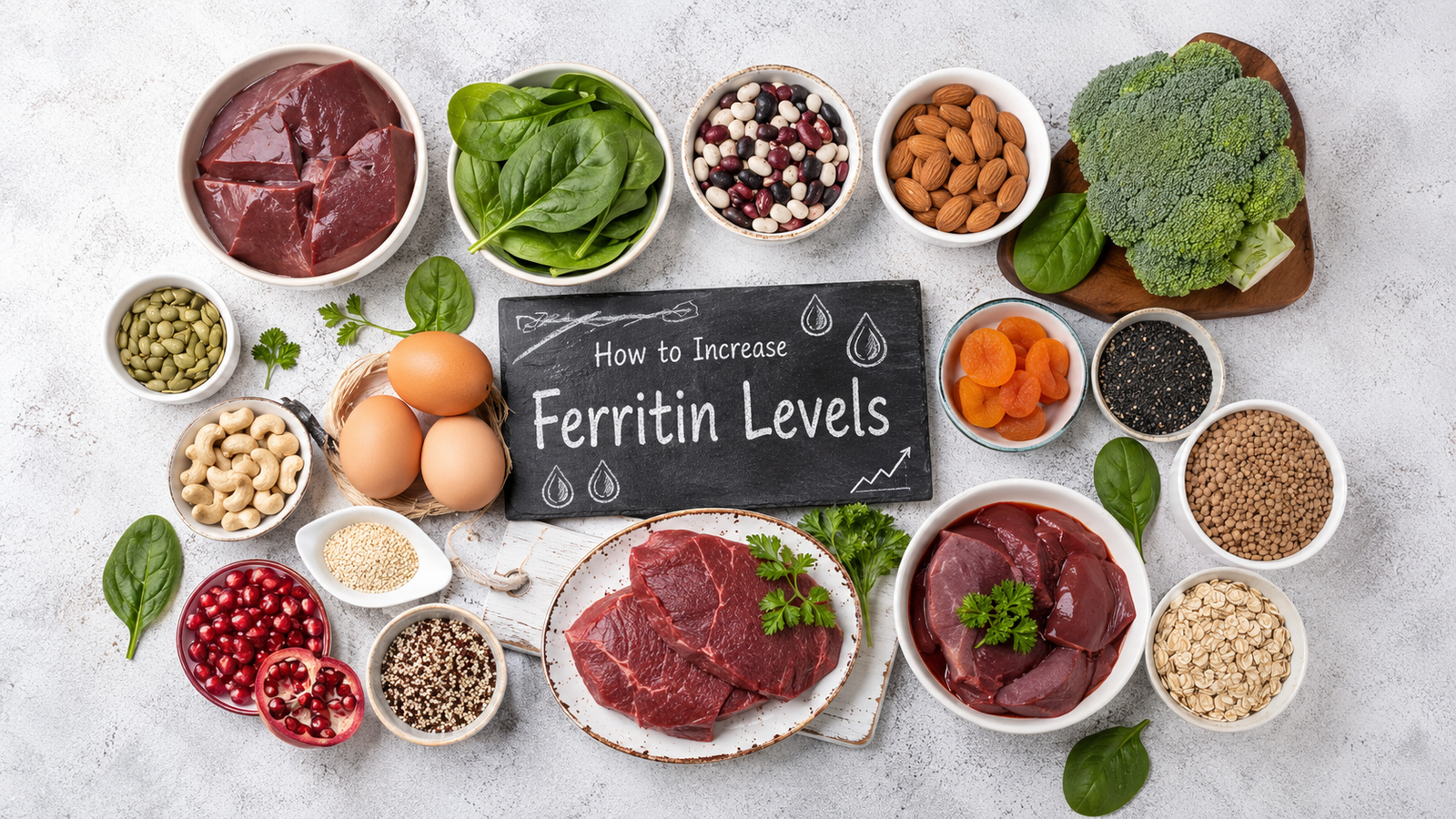
Low ferritin usually means your body’s iron stores are running low. Ferritin is a protein that stores iron, so a ferritin blood test gives healthcare professionals an idea of How to Increase Ferritin Levels. A low result can occur before iron-deficiency anemia develops, which is why understanding how to increase ferritin levels is important even when hemoglobin is still normal.
The most effective way to raise ferritin depends on why it is low. Increasing iron-rich foods can help when dietary intake is inadequate, while an iron supplement may be needed when deficiency is more significant. At the same time, ongoing blood loss, poor iron absorption, pregnancy, or another medical condition may need to be addressed. Simply taking more iron without finding the cause is not always the right approach.
Quick Information Table
| Topic | Key Information |
|---|---|
| What ferritin measures | Your body’s stored iron |
| What low ferritin usually indicates | Low iron stores |
| Common causes | Low dietary iron, blood loss, poor absorption, pregnancy and frequent blood donation |
| Best dietary approach | Eat iron-rich foods regularly |
| Improve absorption | Combine iron-rich foods with vitamin C |
| Foods that can reduce absorption | Tea, coffee and calcium around iron-containing meals or supplements |
| Common treatment | Oral iron supplements when medically appropriate |
| Other treatment | IV iron may be considered when oral iron isn’t effective, isn’t tolerated or rapid replacement is needed |
| Monitoring | Repeat blood tests may be needed |
| Important caution | Don’t take high-dose iron without medical guidance |
| Main goal | Restore iron stores and address the reason they became low |
What Is Ferritin?
Ferritin is a protein that stores iron inside your cells. Your blood ferritin level provides an estimate of the amount of iron your body has stored. When ferritin is low, it generally indicates that your iron reserves are depleted.
Iron is essential for producing hemoglobin, the protein in red blood cells that carries oxygen throughout the body. If iron deficiency continues, the body may eventually be unable to produce enough healthy hemoglobin, resulting in iron-deficiency anemia.
This means someone can have low ferritin without necessarily having anemia yet. As iron stores decline further, symptoms and blood-count abnormalities may become more noticeable.
What Does a Low Ferritin Level Mean?
Laboratories use their own reference ranges, and ferritin values can vary according to age, sex, laboratory methods and other factors.
Cleveland Clinic lists typical ferritin reference ranges of approximately 15–205 ng/mL for females and 30–566 ng/mL for males, while Mayo Clinic gives different typical ranges. This illustrates why an individual result should be interpreted using the reference range provided by the laboratory that performed the test.
A low ferritin result generally suggests insufficient iron stores. However, ferritin is not interpreted in isolation in every situation. Healthcare professionals may also consider hemoglobin, CBC results, serum iron, transferrin saturation and total iron-binding capacity when investigating iron deficiency.
Common Symptoms of Low Iron and Ferritin
Low iron stores may cause no noticeable symptoms at first. As iron deficiency becomes more pronounced, symptoms can include:
- Fatigue
- Weakness
- Dizziness or lightheadedness
- Pale skin
- Shortness of breath
- Fast heartbeat
- Headaches
- Cold hands and feet
- Brittle nails
- A sore or irritated tongue
- Restless legs
- Pica, such as craving or eating ice or other non-food substances
These symptoms can have many different causes, so they don’t prove that ferritin is low. Blood testing is needed to properly evaluate iron status.
How to Increase Ferritin Levels Naturally
One of the first steps for people with inadequate dietary iron is to increase iron-rich foods. However, diet alone may not be enough when iron deficiency is significant or when substantial iron is being lost.
Eat More Heme-Iron Foods
Heme iron is found primarily in animal foods and is generally absorbed more efficiently than the non-heme iron found in plants.
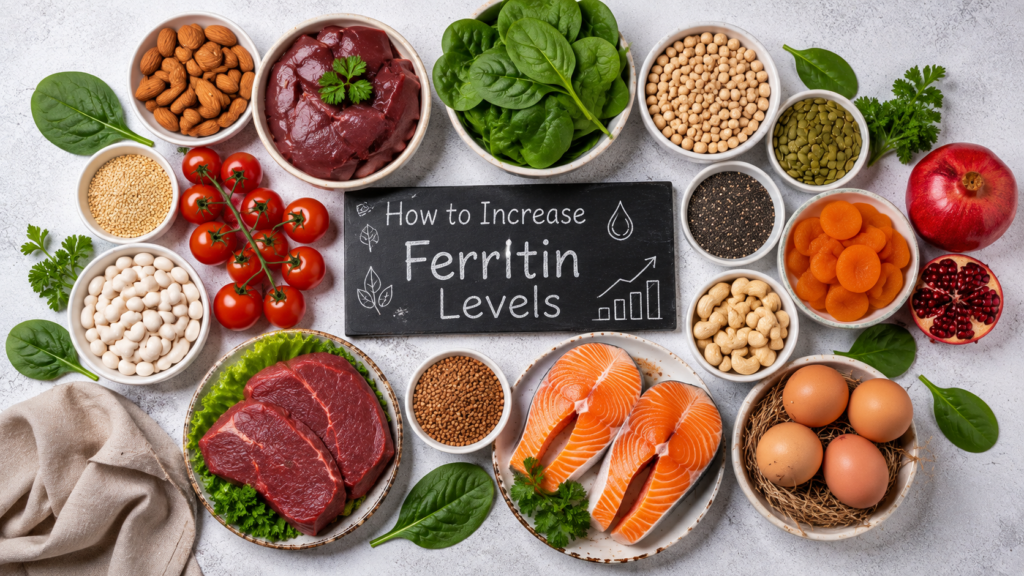
Good sources include:
- Beef
- Lamb
- Pork
- Poultry
- Seafood
- Organ meats
Mayo Clinic lists meat, poultry, seafood and organ meats among foods that provide iron.
Include Plant-Based Iron Sources
People who eat little or no meat can still obtain iron from plant foods.
Useful sources include:
- Beans
- Lentils
- Peas
- Tofu
- Spinach
- Dark leafy greens
- Dried apricots
- Raisins
- Iron-fortified cereals
- Iron-fortified breads and pasta
Mayo Clinic recommends iron-rich plant foods and fortified foods as part of preventing and addressing iron deficiency.
Because non-heme iron is less readily absorbed, vegetarians and vegans may need to pay particular attention to overall iron intake and factors that affect absorption.
Pair Iron With Vitamin C
One of the easiest ways to improve dietary iron absorption is to combine iron-containing foods with foods rich in vitamin C.
Good vitamin C sources include:
- Oranges
- Strawberries
- Kiwi
- Tomatoes
- Bell peppers
- Broccoli
- Melons
- Citrus fruits
Mayo Clinic recommends consuming vitamin-C-rich foods alongside iron-rich foods because vitamin C can improve iron absorption.
For example, a meal containing lentils could be paired with tomatoes or bell peppers. Iron-fortified cereal could be eaten with fruit containing vitamin C.
The goal isn’t to find a single “superfood” that dramatically increases ferritin. Consistently consuming adequate iron and improving absorption is more useful.
Be Careful With Tea and Coffee
Tea and coffee can interfere with iron absorption.
Mayo Clinic recommends avoiding coffee and tea within about an hour of taking iron supplements. Other clinical guidance also recommends limiting tea and coffee around iron-containing meals when trying to maximize absorption.
This doesn’t necessarily mean you have to eliminate coffee or tea. Instead, separating them from iron-rich meals or supplements can help reduce their effect on iron absorption.
Consider Calcium Timing
Calcium can also interfere with iron absorption. Mayo Clinic’s guidance recommends separating iron supplements from antacids, and clinical guidance notes that calcium-containing foods or supplements may interfere with iron absorption.
If you’re taking both iron and calcium supplements, ask your healthcare professional or pharmacist about appropriate timing.
Iron Supplements for Low Ferritin
Diet can be helpful, but people with confirmed iron deficiency are often treated with iron supplements.
GoodRx lists iron supplements as treatments for iron deficiency and iron-deficiency anemia. Common forms include ferrous sulfate, ferrous gluconate and other oral iron preparations. GoodRx also lists intravenous iron products used in appropriate medical situations.
Mayo Clinic states that iron supplements are commonly used to treat iron-deficiency anemia.
Common Oral Iron Forms
Examples include:
- Ferrous sulfate
- Ferrous gluconate
- Ferrous fumarate
- Polysaccharide iron complex
- Ferric maltol
The amount of elemental iron varies between products, so two supplements with the same total tablet weight may provide different amounts of usable iron.
For that reason, choosing an iron supplement based only on the number printed on the front of the bottle can be misleading.
How Should You Take Iron Supplements?
Your healthcare professional may recommend taking an iron supplement on an empty stomach because iron can be absorbed better when food isn’t present. However, iron can cause stomach irritation, nausea or abdominal discomfort. If this happens, taking it with food may make it easier to tolerate.
Mayo Clinic also recommends:
- Taking iron separately from antacids
- Taking iron with vitamin C when appropriate
- Avoiding coffee and tea close to the time you take iron
- Following the prescribed or recommended dose
Antacids can interfere with iron absorption, so Mayo Clinic recommends taking iron two hours before or four hours after antacids.
Iron Supplement Side Effects
Iron supplements can cause gastrointestinal side effects.
Common problems include:
- Constipation
- Nausea
- Stomach cramps
- Vomiting
- Diarrhea
- Dark or black stools
GoodRx specifically lists nausea, constipation, diarrhea, stomach cramps and dark-colored stools among possible effects of iron-containing products.
Mayo Clinic also notes that constipation and black stools can occur with iron supplementation. Black stools caused by iron are generally harmless, although tarry stools or suspected gastrointestinal bleeding should be evaluated medically.
If side effects make it difficult to continue treatment, don’t simply stop treatment or dramatically change the dose on your own. A healthcare professional may be able to adjust the dose, formulation or schedule.
How Long Does It Take to Increase Ferritin?
Ferritin usually does not return to a healthy level overnight.
Mayo Clinic explains that iron supplementation can take several months or longer to rebuild iron stores. People may begin feeling better after about a week or so of treatment, but improvement in symptoms does not necessarily mean iron stores have been fully replenished.
This is why follow-up blood testing can be important.
Your hemoglobin may improve before your body’s iron reserves are completely restored. Your healthcare professional can determine when repeat testing is appropriate.
Why Is Your Ferritin Low?
Increasing ferritin successfully requires understanding why it became low in the first place.
Not Getting Enough Iron
A diet that consistently provides insufficient iron can gradually deplete iron stores.
This can occur in people with restrictive diets, poor overall nutrition or diets that contain very little iron.
Blood Loss
Blood loss is one of the most important causes of iron deficiency.
Heavy menstrual bleeding can cause substantial iron loss. Slow gastrointestinal bleeding can also contribute and may result from conditions involving the stomach or intestines. Mayo Clinic lists gastrointestinal bleeding and heavy periods among causes of iron-deficiency anemia.
Unexplained iron deficiency should therefore not automatically be attributed to diet.
Poor Iron Absorption
Certain gastrointestinal conditions can interfere with iron absorption.
For example, Mayo Clinic identifies celiac disease and some intestinal surgeries as potential reasons the body may not absorb enough iron.
If ferritin remains low despite appropriate supplementation, poor absorption is one possibility that a healthcare professional may investigate.
Pregnancy
Iron requirements increase during pregnancy because the body produces more blood and also needs iron for the developing baby. Pregnancy therefore increases the risk of iron deficiency.
Pregnant people should discuss iron supplementation with their healthcare professional rather than choosing high-dose iron independently.
Frequent Blood Donation
Regular blood donation can contribute to depleted iron stores because blood contains iron. Cleveland Clinic identifies frequent blood donation as one potential cause of low ferritin.
People who donate blood frequently may need their iron status monitored depending on their circumstances.
What If Iron Supplements Don’t Raise Ferritin?
If ferritin doesn’t improve despite taking iron appropriately, simply increasing the dose isn’t necessarily the solution.
Your healthcare professional may investigate:
- Continued blood loss
- Poor absorption
- Incorrect diagnosis
- Medication interactions
- Inadequate adherence because of side effects
- Chronic disease or inflammation
- Another underlying medical condition
Mayo Clinic states that if iron supplements don’t raise blood-iron levels, healthcare professionals need to investigate whether bleeding or problems with iron absorption are responsible.
This is one of the most important principles in treating low ferritin: replace the missing iron while also identifying why the iron became low.
When Is IV Iron Used?
Oral iron is often the initial treatment, but it isn’t suitable for everyone.
Intravenous iron may be considered when oral iron:
- Doesn’t work adequately
- Isn’t tolerated because of side effects
- Cannot be absorbed properly
- Needs to be replaced more quickly in an appropriate clinical situation
Mayo Clinic notes that IV iron may be needed when iron-deficiency anemia is severe, while Mayo’s clinical information also describes IV iron as an option when oral treatment is ineffective or not tolerated.
IV iron is administered under medical supervision because, although serious reactions are uncommon, infusion-related reactions can occur.
Can You Increase Ferritin Without Supplements?
Sometimes.
If ferritin is only mildly reduced because dietary iron intake is inadequate, improving the diet may contribute to restoring iron stores.
However, whether diet alone is sufficient depends on the degree of deficiency and its cause.
Someone losing significant amounts of blood, experiencing substantial iron deficiency, or having an absorption disorder may need medical treatment in addition to dietary changes.
It is therefore better to think of nutrition as one component of iron management, rather than assuming that food alone can correct every low-ferritin result.
Why You Shouldn’t Take High-Dose Iron Without Medical Advice
More iron is not automatically better.
Mayo Clinic warns that excessive iron can accumulate in the body and damage organs, including the liver.
Iron supplements can also cause significant gastrointestinal side effects and, in large enough amounts, iron poisoning can be dangerous. GoodRx lists iron overdose as a serious potential problem with iron-containing products.
For this reason, don’t use high-dose iron simply because you’re tired or because a ferritin value looks low without discussing the result with a healthcare professional.
Can High Ferritin Also Be a Problem?
Yes.
Ferritin isn’t simply a measurement where “higher is always healthier.”
High ferritin can occur because of inflammation, liver disease and other conditions. In some cases, it can be associated with excessive iron storage. Mayo Clinic explains that high ferritin can have several causes, including inflammatory conditions and liver disease.
Therefore, the goal isn’t to push ferritin as high as possible. The goal is to correct iron deficiency when it exists and maintain an appropriate iron balance.
How to Monitor Ferritin Levels
If you’re being treated for iron deficiency, your healthcare professional may repeat blood tests to determine whether treatment is working.
Testing may include:
- Ferritin
- Complete blood count
- Hemoglobin
- Serum iron
- TIBC
- Transferrin saturation
Cleveland Clinic notes that healthcare professionals may order additional blood tests when ferritin results are abnormal, while Mayo Clinic describes ferritin, CBC and other tests as part of evaluating iron deficiency.
The exact testing schedule depends on the severity of the deficiency, treatment being used and the underlying cause.
A Simple Diet Strategy for Supporting Iron Levels
A practical approach is to build meals around an iron source and pair it with vitamin C.
For example:
Breakfast: Iron-fortified cereal with strawberries or another vitamin-C-rich fruit.
Lunch: Lentils or beans with tomatoes and vegetables.
Dinner: Beef, poultry or seafood with vegetables.
If you follow a vegetarian or vegan diet, regularly include beans, lentils, tofu, leafy greens and iron-fortified foods while pairing them with vitamin-C-rich foods.
Try to keep tea and coffee away from your main iron-containing meals when you’re actively trying to maximize iron absorption.
When Should You Talk to a Doctor?
You should discuss low ferritin with a healthcare professional, particularly if the result was significantly below the laboratory’s reference range or you’re experiencing symptoms.
Medical evaluation is especially important if you have:
- Persistent fatigue
- Shortness of breath
- Dizziness
- Fast heartbeat
- Heavy menstrual bleeding
- Unexplained weight loss
- Possible gastrointestinal bleeding
- Persistent low ferritin despite supplementation
- Repeatedly abnormal blood tests
Mayo Clinic advises people with symptoms suggestive of iron-deficiency anemia to consult a healthcare professional rather than attempting to diagnose and treat the condition independently.
Frequently Asked Questions
What is the fastest way to increase ferritin levels?
There isn’t one universally fastest method. Oral iron is commonly used for iron deficiency, while IV iron may be considered in specific situations when oral treatment isn’t effective, isn’t tolerated or rapid replacement is medically appropriate.
What foods increase ferritin?
Iron-rich foods such as meat, seafood, poultry, beans, lentils, tofu, leafy greens and iron-fortified cereals can help provide the iron needed to rebuild stores. Pairing plant-based iron sources with vitamin C can improve absorption.
Does vitamin C increase ferritin?
Vitamin C can improve the body’s absorption of dietary iron, which can support the process of rebuilding iron stores. It is particularly useful when consumed with non-heme, plant-based iron.
How long does it take to raise ferritin?
It can take several months or longer to rebuild iron stores, even when symptoms begin improving sooner. Follow-up blood testing helps determine whether treatment is restoring iron stores adequately.
Can low ferritin occur without anemia?
Yes. Ferritin reflects iron stores, and iron stores can become depleted before anemia develops.
Can coffee lower ferritin?
Coffee doesn’t necessarily cause iron deficiency by itself, but coffee can interfere with iron absorption. Separating coffee from iron supplements and iron-rich meals can help maximize absorption.
Is it safe to take iron every day?
The appropriate dose and schedule depend on the individual and the reason for treatment. Iron can be harmful in excessive amounts, so people shouldn’t take high-dose iron indefinitely without medical guidance.
Final Thoughts
Learning how to increase ferritin levels starts with recognizing that ferritin represents your body’s stored iron. When ferritin is low, improving iron intake through foods can be useful, and medically recommended iron supplements are often used when dietary changes aren’t enough.
The most effective nutritional strategy is to regularly consume iron-rich foods and pair plant-based sources with vitamin C to improve absorption. At the same time, keeping tea and coffee away from iron supplements and iron-focused meals can help reduce interference with absorption.
But raising ferritin isn’t only about consuming more iron. Persistent low ferritin can be caused by blood loss, heavy periods, pregnancy, poor absorption, inadequate dietary intake or frequent blood donation. If supplementation doesn’t improve iron status, identifying the underlying cause becomes particularly important.
Finally, avoid treating ferritin numbers in isolation. The appropriate target depends on your overall health, laboratory results and medical circumstances. Too much iron can also be harmful, so supplementation should be guided by appropriate testing and professional advice.