
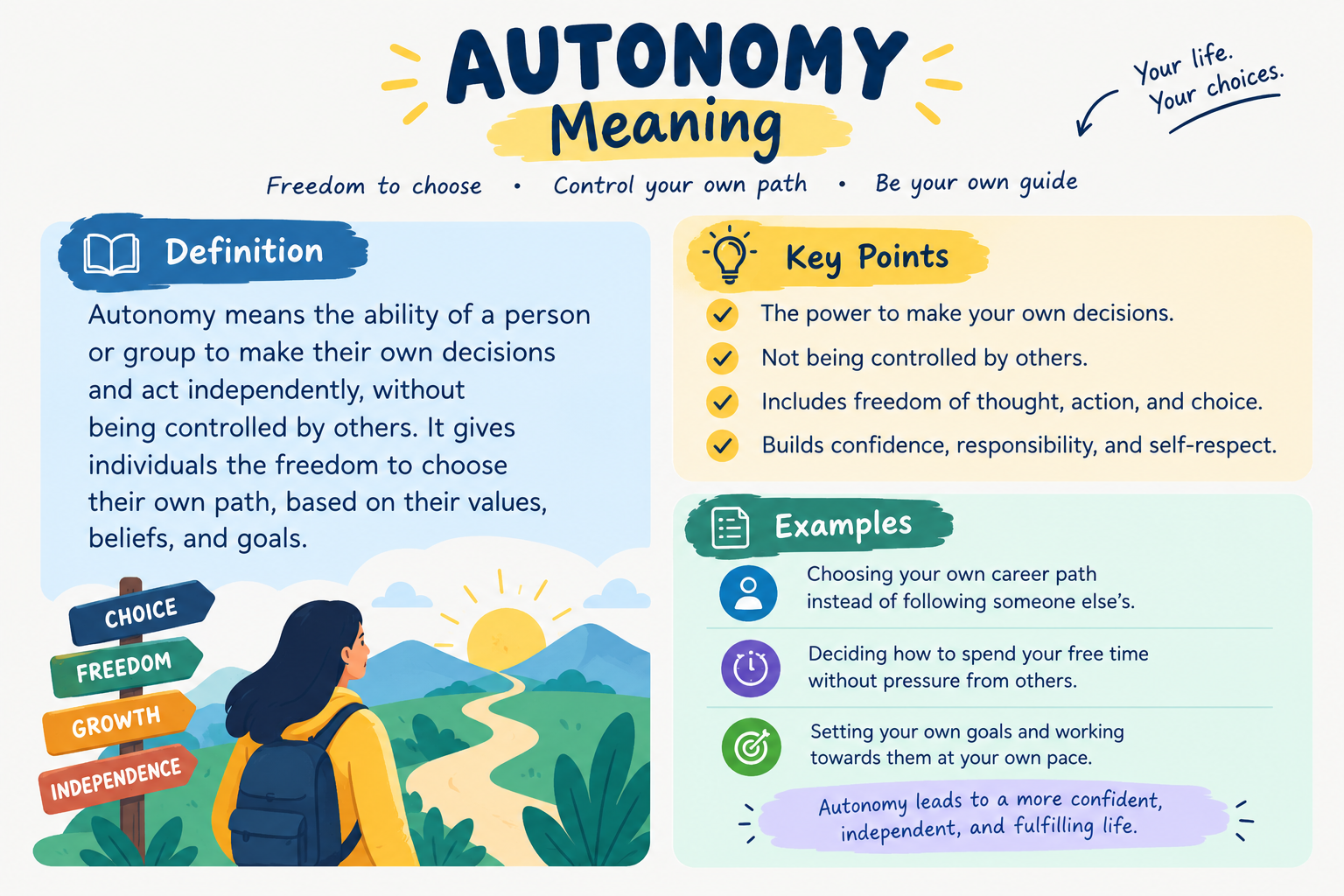
The autonomy meaning centers on independence, self-direction, and the ability or right to make decisions without being controlled by someone else. The word can describe an individual who makes their own choices, a group that governs itself, or a region that has authority to manage certain matters independently. In philosophy, autonomy has an even more specific meaning connected with moral self-determination and the ability to direct one’s actions through reason.
Autonomy is an important concept in everyday life, government, philosophy, law, education, medicine, business, and technology. Although the basic idea remains the same—having control over one’s own decisions—the exact meaning can change depending on the context. Understanding these different uses makes it easier to recognize what people mean when they describe a person, organization, territory, or system as autonomous.
Quick Information Table
| Topic | Information |
|---|---|
| Word | Autonomy |
| Part of speech | Noun |
| Core meaning | Independence and self-direction |
| Main idea | The ability or right to govern or make decisions for oneself |
| Pronunciation | aw-TAH-nuh-mee |
| Plural | Autonomies |
| Common related word | Autonomous |
| Common synonyms | Independence, self-government, self-determination, freedom |
| Opposite concept | Dependence or lack of self-government |
| Origin | Greek, through New Latin |
| First known English use | 1591 |
| Common contexts | Personal, political, philosophical, legal, medical, organizational, technological |

What Does Autonomy Mean?
Autonomy means the quality or state of being independent, free, and self-directing. It can also refer to the quality or state of being self-governing, particularly when discussing a political territory or organization.
In simple terms, autonomy means having the freedom or authority to make your own decisions and control your own actions.
For example, if an employee is trusted to decide how to complete an assignment without constant supervision, that employee may have a high degree of autonomy.
Similarly, if a region has authority to govern certain local matters while remaining part of a larger country, it may have political or regional autonomy.
The central idea in both examples is the same: decision-making power exists within the person, group, or territory rather than being completely controlled from outside.
Autonomy in Simple Words
A simple way to understand autonomy is:
Autonomy = the freedom or ability to make your own decisions.
Consider a teenager who is allowed to choose their own extracurricular activities. They have some personal autonomy because they can make that decision themselves.
Now consider a company department whose manager allows employees to determine how they organize their daily work. The employees have a degree of professional autonomy.
The concept does not necessarily mean complete independence from everyone else. A person can have autonomy while still following laws, responsibilities, agreements, or reasonable limits.
The Origin and History of Autonomy
The history of the word helps explain why its meaning is connected to self-government.
Autonomy ultimately comes from Greek roots associated with self and law. The Greek term autonomia referred to ideas such as self-government and independence. The related Greek adjective autonomos conveyed the idea of being independent or governed by one’s own laws.
The word entered English through New Latin. Its earliest known English use is recorded as 1591, originally in the sense connected with self-government.
Over time, the meaning expanded beyond political territories. The concept began to be applied to individuals, moral decision-making, organizations, and other situations in which someone or something operates with a degree of independence.
The word became particularly important in philosophy, where autonomy came to describe the ability of a rational person to determine their own principles and actions.
Autonomy in Personal Life
Personal autonomy refers to an individual’s ability to make decisions about their own life.
A person may exercise personal autonomy when deciding:
- What career to pursue
- Where to live
- How to spend personal money
- Which activities to participate in
- What personal goals to follow
- How to organize their daily life
Personal autonomy is closely associated with independence and self-direction.
However, autonomy does not mean that a person can ignore every responsibility or consequence. People live within families, communities, workplaces, and legal systems. Their choices can therefore be influenced or limited by legitimate responsibilities and circumstances.
The important distinction is whether the person has meaningful control over their own decisions.
Bodily Autonomy
One important use of the term is bodily autonomy.
Bodily autonomy refers to a person’s ability and right to make decisions concerning their own body. The concept is widely discussed in medical, legal, ethical, and social contexts.
For example, informed medical decision-making is connected to the idea that competent individuals should have a meaningful role in deciding what happens to their own bodies.
Bodily autonomy is therefore more specific than general independence. It focuses on personal authority over one’s physical self and decisions involving one’s body.
Autonomy in Philosophy
Autonomy has a major role in moral philosophy.
In philosophical discussions, autonomy can refer to moral self-determination. The idea is that a person should be capable of directing their choices through reason rather than simply allowing external pressure, authority, or impulses to determine their behavior.
The philosopher Immanuel Kant gave autonomy an especially important role in moral philosophy. In Kantian thought, moral autonomy is connected with the rational will and the idea that a person can give themselves moral principles rather than merely obeying an external authority.
This makes philosophical autonomy more than simply doing whatever one wants.
A person acting autonomously, in this sense, considers reasons and principles when deciding what is right or appropriate.
Autonomy and Free Will
Autonomy and free will are closely related but are not always identical.
Free will generally concerns a person’s ability to choose between possible actions.
Autonomy places greater emphasis on self-direction and the source of the decision.
A person might technically have several choices but still lack meaningful autonomy if another person is controlling their decisions through coercion or manipulation.
Thus, autonomy is often concerned not only with having choices but also with having meaningful control over one’s decisions.
Political Autonomy
Political autonomy refers to the ability of a territory, region, or political community to govern itself to some degree.
An autonomous region may remain part of a larger country while having authority over certain local matters.
For example, an autonomous territory might have authority over areas such as:
- Local administration
- Education
- Cultural affairs
- Certain laws
- Regional economic matters
- Local government
The exact powers depend on the political and constitutional arrangement involved.
Political autonomy therefore does not necessarily mean complete independence.
Autonomy vs. Independence
Autonomy and independence are related, but they can describe different levels of self-rule.
Independence often suggests freedom from external control or authority.
Autonomy can mean having substantial self-government within a larger system.
A region can therefore have autonomy without being a completely independent country.
For example, a territory may remain constitutionally connected to a larger state while managing many of its own internal affairs.
Organizational and Workplace Autonomy
Autonomy is also commonly discussed in workplaces.
An employee with autonomy may be trusted to determine how to accomplish assigned goals without constant supervision.
For example, a manager might tell an employee:
“Complete the project by Friday and decide how you want to organize the work.”
The employee has a clear objective but considerable freedom over the process.
Workplace autonomy can involve:
- Choosing how to complete tasks
- Managing one’s schedule
- Making professional decisions
- Solving problems independently
- Selecting appropriate methods
- Taking responsibility for results
Organizations often use autonomy to encourage responsibility, creativity, initiative, and independent thinking.
However, too much or too little autonomy can create problems. Employees generally need enough freedom to make meaningful decisions while also having clear goals, resources, and accountability.
Autonomy in Education
Autonomy is important in education because students gradually develop the ability to make decisions and take responsibility for learning.
A highly controlled learning environment may give students little opportunity to decide how they approach their work.
By contrast, an educational environment that allows students to choose topics, methods, schedules, or projects can encourage greater independence.
Student autonomy can include:
- Choosing research topics
- Planning study schedules
- Selecting learning methods
- Setting personal academic goals
- Evaluating one’s own progress
The purpose is not simply to let students do whatever they want. Instead, autonomy can help them develop decision-making skills and responsibility.
Autonomy in Medicine
Autonomy is a major ethical principle in healthcare.
In medical decision-making, respect for autonomy generally means recognizing a competent patient’s right to participate in decisions about their treatment.
This principle is closely connected to informed consent.
For example, a patient may receive information about a treatment, its possible benefits and risks, and available alternatives. The patient can then make an informed decision where applicable.
This illustrates an important aspect of autonomy: having the information and freedom necessary to make a meaningful decision.
Autonomy in Business
In business, autonomy can describe the independence given to employees, teams, departments, managers, or subsidiaries.
A company may allow a regional team to make local decisions without requiring approval for every minor issue.
For example, a marketing team might have autonomy over campaign design while still operating within the company’s overall brand and financial guidelines.
Business autonomy can encourage:
- Faster decision-making
- Creativity
- Responsibility
- Problem-solving
- Employee engagement
- Local adaptation
At the same time, organizations usually balance autonomy with accountability and shared objectives.
Autonomy in Technology
The meaning of autonomy has expanded significantly with advances in technology.
In technology, an autonomous system is generally capable of carrying out tasks and, depending on the system, adapting to information without requiring direct human guidance for every action.
Examples can include autonomous vehicles, robotic systems, and certain computerized systems.
Technological autonomy is different from human autonomy.
When discussing a person, autonomy refers to independence and self-directed decision-making. When discussing a machine, autonomy generally describes its ability to perform tasks without continuous direct human intervention.
Autonomous Vehicles
An autonomous vehicle can use sensors, software, and computerized decision-making systems to perform some driving tasks with varying degrees of independence.
The word autonomous in this context does not necessarily mean that a vehicle can perform every driving task under every possible condition without human involvement.
Different systems can have different levels of automation and operational capabilities.
Autonomy vs. Autonomous
The two words are closely related but serve different grammatical roles.
Autonomy is a noun.
Example:
“The employee was given greater autonomy.”
Autonomous is an adjective.
Example:
“The employee works in an autonomous team.”
In simple terms:
- Autonomy = independence or self-government
- Autonomous = independent or self-governing
The adjective can describe people, organizations, territories, systems, and machines depending on the context.
Synonyms of Autonomy
Several words have meanings that overlap with autonomy.
Common related terms include:
- Independence
- Freedom
- Self-government
- Self-governance
- Self-determination
- Self-direction
- Sovereignty
- Choice
- Free will
- Discretion
These words are not always interchangeable.
For example, sovereignty generally carries a stronger political meaning, while self-direction may be more appropriate when discussing an individual’s behavior.
Opposite of Autonomy
The opposite of autonomy is generally associated with dependence, external control, or lack of self-government.
Related contrasting concepts include:
- Dependence
- Subjection
- Control
- Coercion
- Subjugation
- Heteronomy
The precise opposite depends on context.
For example, political autonomy may contrast with external political control, while personal autonomy may contrast with coercion or excessive dependence.
Examples of Autonomy in Sentences
Here are several examples showing how the word can be used naturally:
“The manager gave the team greater autonomy over its daily operations.”
This means the team received more freedom to make its own decisions.
“Personal autonomy is important when making major life decisions.”
Here, autonomy refers to an individual’s ability to direct their own life.
“The territory has considerable political autonomy.”
This means the territory has authority to govern certain matters independently.
“The researcher valued the autonomy to pursue her own ideas.”
In this example, autonomy means professional freedom and independence.
“The system can perform certain tasks with a high degree of autonomy.”
Here, the word refers to a technological system operating without continuous direct intervention.
Why Autonomy Is Important
Autonomy matters because decision-making power can influence responsibility, dignity, creativity, and independence.
When people have appropriate autonomy, they can take ownership of their choices and actions. In workplaces, this can encourage initiative. In education, it can support independent learning. In healthcare, it can help respect individual decision-making. In political systems, autonomy can provide communities with authority over local affairs.
At the same time, autonomy is rarely absolute.
People and organizations operate within laws, responsibilities, relationships, resources, and practical limitations. A healthy form of autonomy often means having meaningful control while recognizing legitimate boundaries.
Common Misunderstandings About Autonomy
One common misunderstanding is that autonomy means complete freedom with no rules.
That is not necessarily the case.
A person can have autonomy while following laws, workplace policies, ethical principles, or personal responsibilities.
Another misconception is that autonomy always means doing everything alone. A person can seek advice, cooperate with others, and still make an autonomous decision.
Autonomy is therefore better understood as meaningful self-direction, rather than isolation or unlimited freedom.
Frequently Asked Questions About Autonomy Meaning
What is the simple meaning of autonomy?
Autonomy means having the freedom, authority, or ability to make your own decisions and direct your own actions.
What does autonomy mean in a person?
For a person, autonomy generally means having meaningful control over personal decisions, choices, and actions.
What is an example of autonomy?
An employee who is trusted to decide how to complete a project has workplace autonomy. A person making their own informed choices about their life is exercising personal autonomy.
What is political autonomy?
Political autonomy is the ability or right of a territory or community to govern itself in certain areas while potentially remaining part of a larger political system.
Is autonomy the same as independence?
They are closely related, but not always identical. Independence generally emphasizes freedom from external control, while autonomy can refer to self-government or self-direction within a larger framework.
What is bodily autonomy?
Bodily autonomy refers to a person’s ability and right to make decisions concerning their own body.
What is the opposite of autonomy?
Depending on the context, the opposite can involve dependence, external control, coercion, subjection, or lack of self-government.
What is the adjective form of autonomy?
The adjective form is autonomous. It describes someone or something that is independent, self-governing, or capable of operating without direct external control.
How is autonomy used in technology?
In technology, autonomy commonly describes a system’s ability to perform tasks and respond to information without requiring direct human intervention at every stage.
Final Thoughts on Autonomy Meaning
The autonomy meaning is fundamentally connected to independence, self-direction, and self-government. At its simplest, autonomy is the ability or right to make decisions for oneself rather than being completely controlled by someone else.
The concept can apply to individuals, communities, governments, employees, organizations, patients, students, and technological systems. Its meaning changes slightly across these contexts, but the central idea remains consistent: having meaningful authority over one’s own decisions or actions.
Autonomy is also more nuanced than simply having unlimited freedom. A person can be autonomous while respecting laws, responsibilities, relationships, and ethical boundaries. In philosophy, it can refer to rational moral self-determination; in politics, it can describe self-government; in workplaces, it can mean professional independence; and in technology, it can describe systems capable of performing tasks without continuous human direction.
Understanding these different uses makes the word easier to recognize and apply accurately in everyday, professional, philosophical, and technical communication.