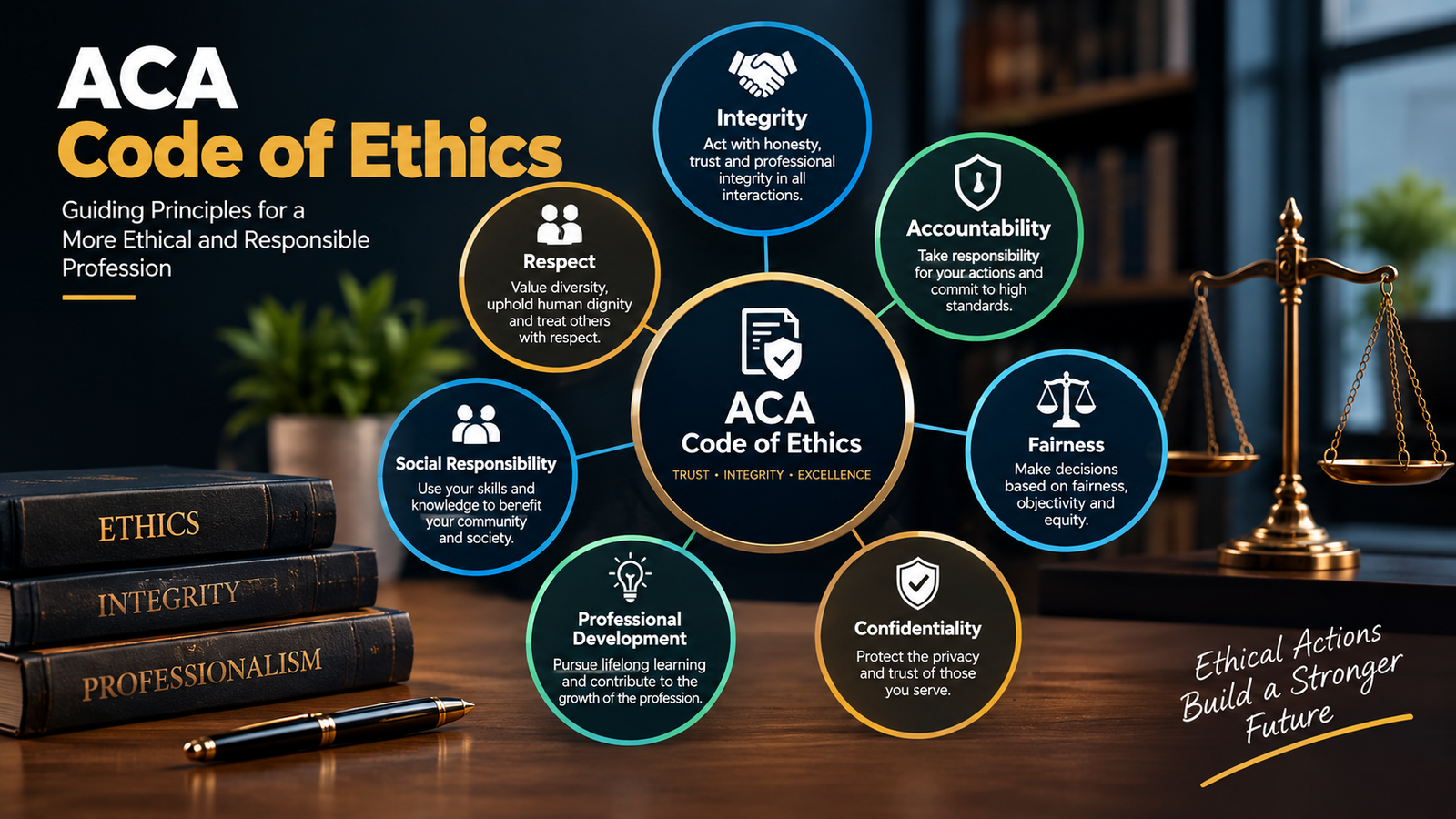
The ACA Code of Ethics is a professional ethical framework developed by the American Counseling Association (ACA) to guide counselors, counselor educators, supervisors, researchers, and counselors-in-training in their professional responsibilities. It establishes ethical principles and standards covering the counseling relationship, confidentiality, professional conduct, assessment, supervision, research, technology, and ethical decision-making.
As of September 2026, the 2014 edition remains the established published code, but an important revision is underway. The ACA’s current revision project says its task force is reviewing submitted comments and preparing a final revised code, with publication planned for fall 2026. The draft is currently unavailable while that process is being completed.
This makes the ACA Code of Ethics particularly important to understand at the present time because counselors are working under the established standards while the profession prepares for a new version.
Quick Information About the ACA Code of Ethics
| Feature | Details |
|---|---|
| Full name | American Counseling Association Code of Ethics |
| Organization | American Counseling Association |
| Current established edition | 2014 Code of Ethics |
| Previous edition | 2005 |
| Major revision underway | Yes |
| Expected revised edition | Fall 2026 |
| Main purpose | Ethical guidance for professional counseling |
| Core professional values | 5 |
| Fundamental ethical principles | 6 |
| 2014 sections | 9 |
| Major areas | Counseling, confidentiality, professional responsibility, assessment, supervision, research, technology and ethical issues |
| 2026 revision structure | 10 sections listed by ACA’s current revision project |
| Applies particularly to | ACA members and counseling professionals using the code as an ethical framework |
| Main emphasis | Client welfare, professional responsibility, competence and ethical decision-making |
| Category | Education |

What Is the ACA Code of Ethics?
The ACA Code of Ethics is a formal collection of professional ethical standards created to help counselors understand their responsibilities toward clients, colleagues, the profession, and the public.
The code is more than a simple list of rules. Its preamble identifies professional values and ethical principles that counselors can use when confronting situations where there may not be one obvious answer. The code specifically recognizes that difficult ethical questions require a thoughtful decision-making process rather than automatic application of a single rule.
The code also distinguishes ethical standards from legal requirements. A violation of an ethical standard does not automatically establish legal liability or prove that a law has been broken. Legal questions are determined through applicable laws and legal proceedings.
This distinction is important because counselors often have to consider ethics, law, professional standards, institutional policies, and client welfare simultaneously.
Purpose of the ACA Code of Ethics
The code identifies six primary purposes.
It establishes ethical obligations for ACA members and provides guidance for professional counseling practice. It also identifies ethical considerations relevant to counselors and counselors-in-training.
Another purpose is to clarify the ethical responsibilities shared by ACA members and to provide a framework for deciding what course of action best serves people who use counseling services.
The code also supports the mission of the association and provides standards used when ACA ethics inquiries and complaints involving members are processed.
These purposes show that the code has both an educational and professional function.
It helps counselors understand expected conduct while also providing a framework for addressing concerns about professional behavior.
Five Core Professional Values
The preamble to the ACA Code of Ethics identifies five core professional values.
Enhancing Human Development
Counseling is intended to support human development throughout the lifespan.
This means ethical counseling is not limited to addressing symptoms or immediate problems. Counselors also consider clients’ growth, goals, capabilities, relationships, education, careers, wellness, and broader development.
Honoring Diversity
The code emphasizes respect for diversity and a multicultural approach.
Counselors are expected to recognize the worth, dignity, potential, and uniqueness of people within their social and cultural environments.
This principle is important because clients come from different cultural, racial, ethnic, socioeconomic, religious, linguistic, gender, disability, and family backgrounds.
Promoting Social Justice
Social justice is identified as another professional value.
This places attention on fairness, equality, access, and the social conditions that can affect people’s lives and ability to obtain services.
Protecting the Counselor-Client Relationship
The counselor-client relationship depends heavily on trust.
The code therefore identifies safeguarding the integrity of this relationship as a fundamental professional value. Maintaining appropriate boundaries, protecting confidentiality, obtaining informed consent, and avoiding exploitation are closely connected with this responsibility.
Practicing Competently and Ethically
Counselors are expected to practice within their professional competence and to maintain ethical standards.
Competence involves having appropriate knowledge and skills, recognizing limitations, obtaining additional training when necessary, and seeking consultation when an issue exceeds one’s expertise.
Six Fundamental Ethical Principles
The ACA Code of Ethics also identifies six fundamental principles of professional ethical behavior.
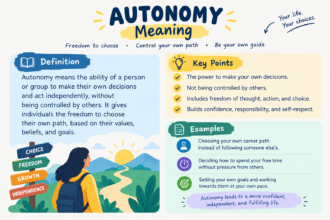
Autonomy
Autonomy refers to respecting a person’s right to control the direction of their own life.
In counseling, this means recognizing clients as participants in decisions about their treatment and goals rather than treating them as passive recipients of professional decisions.
Nonmaleficence
Nonmaleficence means avoiding actions that cause harm.
Counselors should consider potential risks associated with interventions, decisions, disclosures, boundaries, and professional conduct.
Beneficence
Beneficence means working for the good of clients and society by promoting mental health and well-being.
It encourages counselors to consider how their professional actions can positively support clients.
Justice
Justice involves equitable treatment, fairness, and equality.
It is particularly relevant when counselors make decisions about access to services, treatment, referrals, assessment, and professional opportunities.
Fidelity
Fidelity involves honoring commitments and maintaining trust.
The counselor-client relationship depends on counselors keeping professional promises and acting consistently with their responsibilities.
Veracity
Veracity means dealing truthfully with people encountered in professional practice.
Honest communication can be particularly important when discussing treatment, limitations, fees, risks, records, confidentiality, and professional qualifications.
The Nine Sections of the 2014 Code
The 2014 ACA Code of Ethics contains nine major sections.
Section A: The Counseling Relationship
Section A addresses the counselor-client relationship.
Topics include client welfare, informed consent, client autonomy, counseling plans, records, boundaries, relationships with former clients, interruptions in counseling, referrals, and termination.
The central idea is that counselors have professional responsibilities within a relationship where clients may be vulnerable.
Section B: Confidentiality and Privacy
Confidentiality is one of the most recognizable ethical responsibilities in counseling.
Section B addresses protecting client information and explains circumstances in which confidentiality may have limits or disclosures may become necessary.
Issues involving records, consultations, releases of information, subpoenas, and other disclosures require careful consideration.
ACA has previously highlighted confidentiality and release-of-information questions as common areas where counselors seek ethics guidance.
Section C: Professional Responsibility
Section C focuses on professional conduct and counselor responsibilities.
It includes areas such as competence, professional development, advertising, records, responsibility to clients and the profession, and maintaining appropriate professional standards.
Professional responsibility also means recognizing when consultation, supervision, or additional training is needed.
Section D: Relationships With Other Professionals
Counseling frequently involves cooperation with other professionals.
Section D addresses professional relationships and collaboration.
Counselors may work alongside physicians, psychologists, social workers, educators, administrators, attorneys, and other professionals. Ethical collaboration requires respect for different roles while keeping client welfare central.
Section E: Evaluation, Assessment, and Interpretation
Section E addresses assessment and evaluation.
Counselors may use tests and other assessment tools for purposes such as diagnosis, treatment planning, educational planning, or career counseling.
Ethical assessment requires appropriate competence and attention to factors that can influence interpretation, including cultural and individual differences.
Section F: Supervision, Training, and Teaching
Section F addresses counselors who supervise, teach, train, or evaluate other counselors and students.
The section includes topics such as:
- Supervisor competence
- Client welfare
- Informed consent
- Supervisory relationships
- Sexual relationships
- Evaluation
- Gatekeeping
- Remediation
- Counselor educator responsibilities
- Teaching ethics
- Multicultural considerations
The 2014 code specifically includes standards for online supervision and other modern training situations.
Section G: Research and Publication
Section G addresses ethical responsibilities associated with research and publication.
Research involving human participants requires attention to informed consent, privacy, confidentiality, risks, appropriate methodology, and responsible reporting.
Counselors involved in academic research therefore have ethical responsibilities beyond ordinary clinical practice.
Section H: Distance Counseling, Technology, and Social Media
Section H was one of the particularly significant additions in the 2014 code.
Technology had transformed counseling practice substantially between 2005 and 2014, leading the revision task force to address distance counseling, technology, and social media more explicitly.
This section addressed issues such as:
- Distance counseling
- Electronic communication
- Technology use
- Social media
- Online professional boundaries
- Confidentiality in electronic environments
- Counselor competence with technology
Its inclusion was significant because social media had become a major part of professional and personal life by the time the 2014 code was adopted.
Section I: Resolving Ethical Issues
Section I addresses what counselors should do when ethical problems arise.
The code does not claim that one decision-making model will always work best. Instead, counselors are expected to use a credible ethical decision-making approach capable of withstanding public scrutiny.
This section encourages counselors to consider the circumstances, applicable ethical standards, professional values, and relevant resources.
Confidentiality and Its Importance
Confidentiality is central to the counseling relationship because clients often share highly personal information.
Without a reasonable expectation of privacy, clients may hesitate to discuss sensitive experiences.
The ACA Code of Ethics therefore provides standards concerning the protection and disclosure of client information.
However, confidentiality is not absolute.
Counselors must understand applicable laws and professional requirements concerning circumstances such as threats, abuse reporting, court orders, and other legally regulated disclosures.
ACA’s own ethics guidance has emphasized that mandated reporting requirements can vary by jurisdiction, meaning counselors need to understand applicable state requirements rather than relying on the ethics code alone.
Informed Consent
Informed consent is another important concept.
Clients should have meaningful information about counseling so they can participate in decisions concerning their care.
Depending on the situation, this can involve information about:
- Nature of counseling
- Goals
- Services
- Risks and benefits
- Counselor qualifications
- Fees
- Confidentiality
- Limitations of confidentiality
- Records
- Technology
- Communication procedures
Informed consent is not simply a signature on a form. Ethical practice involves communication that helps clients understand the professional relationship and make informed choices.
Counselor Competence
Competence is a recurring theme throughout the ACA Code of Ethics.
Counselors should have appropriate education, training, knowledge, skills, and experience for the services they provide.
When counselors encounter an area outside their competence, ethical practice may require consultation, supervision, additional education, referral, or another appropriate response.
The code’s emphasis on competence is closely connected to client welfare because inadequate knowledge or skills can create risks for clients.
Personal Values and Counseling
One of the major ethical issues addressed during the 2014 revision was the relationship between counselor personal values and professional responsibilities.
The revision process specifically identified personal values as a major area requiring clarification. ACA’s discussion of the revised code emphasized that referrals should be based on competence rather than simply using personal values as a reason to avoid serving a client.
This issue illustrates an important distinction:
A counselor can have personal beliefs while still having professional responsibilities toward clients whose beliefs or life circumstances differ from their own.
The code therefore emphasizes professional obligations, multicultural competence, client welfare, and appropriate referrals.
Technology and Social Media
Technology has become even more important since the 2014 code was adopted.
Online counseling, electronic records, email, text messaging, video sessions, social media, and digital platforms all create ethical considerations.
Counselors need to think about:
- Privacy
- Security
- Professional boundaries
- Identity verification
- Emergency procedures
- Informed consent
- Technology competence
- Record keeping
- Appropriate communication
The 2014 code was notable because it became the first ACA code to explicitly address social-media ethics with clients.
The growing role of technology is also one reason the upcoming revision is significant.
Ethical Decision-Making
Ethical counseling often involves situations where two or more professional responsibilities appear to conflict.
For example, a counselor may need to consider confidentiality while also responding to a safety concern or legal requirement.
The ACA Code of Ethics treats ethical decision-making as a process.
A counselor may need to:
- Identify the ethical problem.
- Review the applicable standards.
- Consider relevant laws.
- Identify affected individuals.
- Consider professional values and principles.
- Consult appropriate professionals or resources.
- Consider possible courses of action.
- Evaluate potential consequences.
- Choose and document an appropriate response.
- Reassess the outcome when necessary.
The exact process can vary, but the underlying principle is deliberate and defensible professional reasoning.
History of the ACA Code of Ethics
The ACA ethics code has developed alongside the counseling profession.
The 2005 edition preceded the current 2014 code.
The 2014 revision process involved extensive work by an Ethics Revision Task Force. ACA reported that the process included years of work, conference meetings, town halls, and feedback from more than 100 ACA members.
The revised code was approved by the ACA Governing Council in March 2014 and replaced the 2005 edition.
Technology, social media, personal values, multiculturalism, boundaries, distance counseling, confidentiality, record keeping, diagnosis, and other issues received attention during the revision.
The revision demonstrates why professional ethics codes are periodically updated: counseling practice changes as technology, law, society, and professional knowledge change.
The 2026 ACA Code of Ethics Revision
One of the most important current developments is the 2026 revision.
The ACA’s current official project states that its Ethics Code Revision Task Force is reviewing submitted comments and preparing the final revised code. The draft is currently unavailable while this work continues. ACA says the final version will be published in fall 2026.
The structure displayed by the current revision project contains 10 sections rather than the nine sections of the 2014 code:
- The Counseling Relationship
- Confidentiality and Privacy
- Professional Responsibility
- Relationships With Other Professionals
- Evaluation, Assessment, and Interpretation
- Supervision, Training, and Teaching
- Research and Publication
- Telehealth and Technology
- Forensic Practice
- Resolving Ethical Issues
The addition of Forensic Practice as a separate section and the reframing of technology as Telehealth and Technology are notable structural changes shown by the current ACA project.
However, because the draft is presently unavailable, the final wording and exact standards of the 2026 code should not be assumed from the table of contents alone.
Is the 2014 Code Still Important in 2026?
Yes.
The current revision project does not present the new code as already finalized. It says the task force is still preparing the final version for publication in fall 2026.
A recent 2026 overview similarly describes the 2014 edition as the active published standard while the profession awaits the revised version.
Therefore, articles or study materials discussing the ACA Code of Ethics in September 2026 should clearly distinguish between:
The established 2014 code and the forthcoming 2026 revision.
This distinction prevents readers from accidentally treating proposed or forthcoming standards as already finalized requirements.
Why the ACA Code of Ethics Matters
Ethical standards protect the integrity of counseling relationships.
Counseling clients may share information about trauma, relationships, health, family circumstances, sexuality, finances, employment, education, or other deeply personal areas of life.
The counselor therefore has significant professional responsibilities.
The ACA Code of Ethics provides a common framework for thinking about these responsibilities, including:
- Client welfare
- Privacy
- Confidentiality
- Professional competence
- Boundaries
- Diversity
- Social justice
- Assessment
- Supervision
- Research
- Technology
- Ethical decision-making
The code also helps establish expectations for professional conduct within the counseling profession.
ACA Code of Ethics vs. Law
An important misconception is that an ethics code and the law are identical.
They are not.
The ACA Code of Ethics establishes professional ethical standards, while laws are established by governmental authorities and enforced through legal systems.
The code itself explicitly notes that violating an ethical standard does not necessarily mean that someone has violated the law.
Counselors therefore need to consider both.
A particular situation may involve:
- ACA ethical standards
- State licensing laws
- Federal law
- Court orders
- Employer policies
- Professional standards
- Institutional procedures
When these issues become complicated, consultation with qualified legal or ethics professionals may be appropriate.
Final Thoughts
The ACA Code of Ethics is one of the central professional resources for understanding ethical responsibilities in counseling. The 2014 edition established a detailed framework covering the counseling relationship, confidentiality, professional responsibility, relationships with other professionals, assessment, supervision, research, technology, and ethical decision-making.
Its foundation includes five core professional values: enhancing human development, honoring diversity, promoting social justice, safeguarding the counselor-client relationship, and practicing competently and ethically. Six fundamental principles—autonomy, nonmaleficence, beneficence, justice, fidelity, and veracity—provide an additional conceptual foundation for ethical behavior.
The 2014 edition was particularly significant because it expanded ethical guidance around technology, social media, distance counseling, multiculturalism, professional boundaries, personal values, and other issues that had become increasingly important in modern counseling.
The biggest current development is the 2026 revision. As of September 2026, the ACA’s official revision project says the task force is reviewing comments and preparing a final code, with publication planned for fall 2026. The draft is not currently available, so the final standards should not be inferred until ACA formally publishes the new edition.
For students and practicing counselors, understanding the ACA Code of Ethics is therefore not simply about memorizing individual rules. It involves learning how professional values, ethical principles, client welfare, competence, confidentiality, law, cultural considerations, technology, and careful ethical decision-making work together in real counseling situations.