
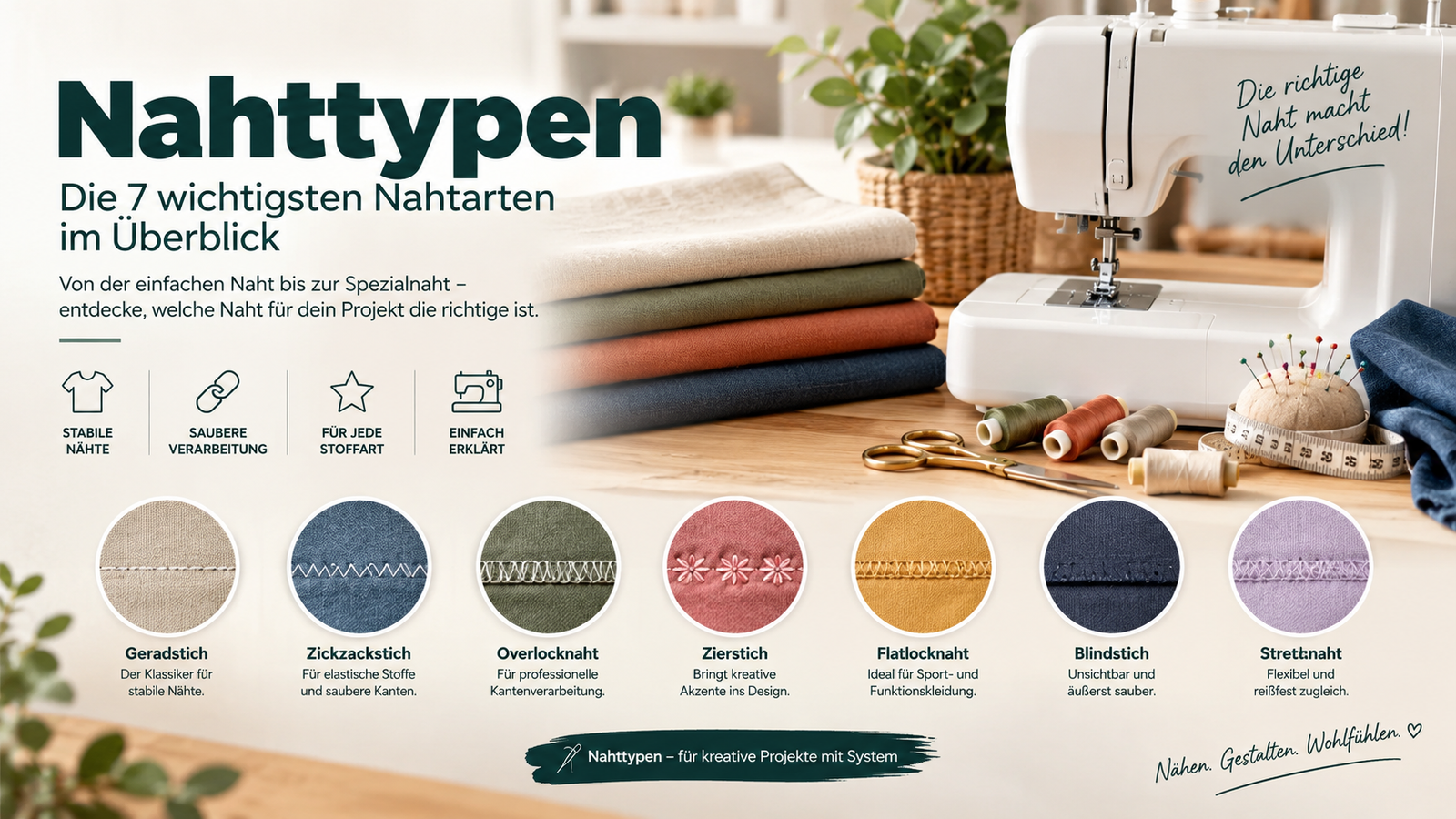
Nahttypen is a German plural term that generally refers to different types of seams or joining methods. The most common meaning is seam types in sewing and textile construction, but the word can also appear in welding, metalworking, and medical contexts. The exact English translation therefore depends on the subject in which the term is being used.
In clothing and textile production, Nahttypen describes the different ways fabric pieces are joined. A seam can influence the strength, flexibility, appearance, comfort, durability, and finishing of a garment. In welding, the same basic idea is applied to connections between metal components, while in medicine it can refer to different methods of closing wounds with sutures.
Quick Information About Nahttypen
| Feature | Details |
|---|---|
| German term | Nahttypen |
| Basic meaning | Types of seams / joining methods |
| Singular | Nahttyp |
| Main textile meaning | Different ways of joining fabric |
| Common sewing examples | Plain, French, flat-felled, overlock, flatlock |
| Welding meaning | Weld or joint types |
| Medical meaning | Suture types or techniques |
| Main factors | Strength, flexibility, appearance, durability and purpose |
| Used by | Sewers, tailors, designers, manufacturers, welders and medical professionals |
| Important consideration | Meaning depends on context |
| Category | Fashion |
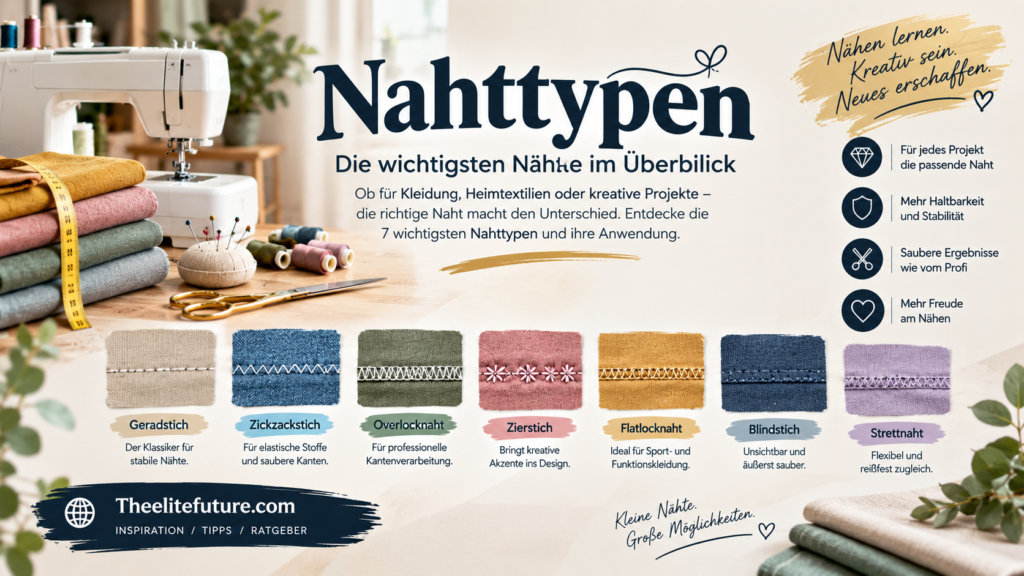
What Does Nahttypen Mean?
The word Nahttypen consists of two German elements. “Naht” refers broadly to a seam, joining line, weld seam, or suture, while “Typen” means types. In its simplest form, Nahttypen can therefore be translated as “types of seams.”
However, translating the word without considering its context can create confusion.
For example, if Nahttypen appears in a German sewing pattern, it will normally concern fabric construction. If it appears in an engineering document, it may concern welds or joint configurations. In a medical document, it may refer to surgical sutures.
The common idea connecting these uses is joining two or more parts together.
This makes Nahttypen an especially useful technical term because different industries use different joining techniques depending on their materials and requirements.
Nahttypen in Sewing and Textile Work
The most common interpretation of Nahttypen is seam types in sewing.
A seam is the area where two or more pieces of fabric are joined. The construction of that seam can affect how the finished product looks and performs. A seam designed for lightweight clothing may not be appropriate for heavy denim, while a seam used in sportswear may need more flexibility than one used in a structured jacket.
Seam selection can influence:
- Strength
- Durability
- Flexibility
- Comfort
- Appearance
- Edge protection
- Bulk
- Resistance to repeated washing
- Resistance to pulling and stretching
- Overall garment quality
This is why professional garment construction uses different Nahttypen rather than relying on one universal seam.
Plain Seam
The plain seam is one of the simplest and most widely used seam constructions.
Two fabric pieces are positioned together and stitched along their edges. The method is straightforward, relatively quick, and suitable for many everyday sewing projects.
Plain seams are commonly found in garments such as:
- Shirts
- Dresses
- Skirts
- Trousers
- Home textiles
- Simple fabric accessories
One limitation is that the raw fabric edges may remain exposed on the inside. Depending on the fabric, these edges can fray over time. A separate seam finish may therefore be required.
Because of its simplicity, the plain seam is also commonly introduced to beginners learning basic sewing techniques.
French Seam
A French seam is designed to enclose the raw edges of fabric within the seam.
This gives the inside of a garment a clean appearance and reduces direct exposure of the fabric edges. It is particularly useful for lightweight, fine, or sheer fabrics where visible raw edges would be undesirable.
French seams can be especially attractive in garments where the inside construction is visible or where a neat finish is important.
The technique requires more construction steps than a basic plain seam because the fabric is folded and stitched in a way that encloses the edges.
Flat-Felled Seam
A flat-felled seam is known for its strength and clean enclosed construction.
The seam allowances are folded and secured so that raw edges are hidden. This produces a durable seam that can tolerate considerable wear.
Flat-felled seams are commonly associated with:
- Jeans
- Workwear
- Heavy garments
- Durable trousers
- Other products exposed to repeated stress
They can also provide an attractive professional finish. Their construction makes them especially useful where durability is more important than achieving the quickest possible sewing process.
Overlock Seams
An overlock seam uses thread that wraps around the fabric edge while joining or finishing the material.
Overlock machines, commonly called sergers in some English-speaking sewing communities, can process fabric edges efficiently and are widely used in garment production.
One major advantage is edge control. The thread structure helps reduce fraying while creating a finished edge.
Overlock construction is particularly useful in clothing manufacturing because it can combine joining and edge finishing in one operation.
It is also frequently used for knitted or stretch fabrics where flexibility and efficient edge finishing are important.
Flatlock Seams
A flatlock seam is constructed so that the finished seam lies relatively flat against the fabric.
Reducing bulk can be valuable in clothing worn close to the body. A bulky seam can create pressure or rubbing, especially during movement.
Flatlock seams are therefore frequently associated with:
- Sportswear
- Activewear
- Underwear
- Stretch garments
- Performance clothing
The construction can provide both functional and visual benefits, especially when the garment needs flexibility and a low-profile seam.
Seam Types and Fabric Selection
There is no single seam that works perfectly for every fabric.
The material itself should be considered before choosing a Nahttyp.
Lightweight Fabrics
Silk, chiffon and other lightweight materials can benefit from seams that provide neat internal finishing without adding excessive bulk. French seams can be appropriate in suitable projects.
Heavy Fabrics
Denim, canvas and workwear fabrics generally require construction capable of handling greater stress. Stronger seam structures such as flat-felled seams can be useful.
Stretch Fabrics
Stretch materials require seams that can accommodate movement without breaking or restricting the garment. Overlock and specialized stretch-compatible constructions are commonly useful.
Delicate Fabrics
Delicate fabrics require careful handling because aggressive stitching, unsuitable thread tension, or excessive seam bulk can damage the material.
The best Nahttyp therefore depends not only on the desired appearance but also on how the fabric behaves.
Why Seam Classification Matters
Professional textile manufacturing needs consistent terminology.
A garment may be designed in one country, manufactured in another, inspected somewhere else, and sold globally. If each production team uses different terminology, misunderstandings can occur.
Structured seam classifications help designers, manufacturers, pattern makers, sewing professionals, and quality-control teams communicate more accurately.
The textile field also uses standards such as ISO 4916 to classify seam types and provide a systematic method for describing seam construction.
For beginners, it is not necessary to memorize every classification. Understanding the main construction principles is more important initially.
Nahttypen in Welding and Metalworking
Nahttypen is not limited to textiles.
In welding and metalworking, Naht can refer to a weld seam, while Nahttypen can describe different weld forms or joining configurations. The appropriate English translation may therefore be weld types, weld seam types, or, depending on the context, joint types.
Metal components can be joined in different configurations. They may meet edge-to-edge, overlap, or meet at an angle.
The geometry of the joint affects:
- Edge preparation
- Welding procedure
- Required penetration
- Strength
- Material thickness
- Accessibility
- Final weld shape
For this reason, technical drawings and applicable welding standards are important when interpreting German welding terminology.
Common Welding Nahttypen
Several German welding terms demonstrate how varied Nahttypen can be.
I-Naht
An I-Naht is associated with a relatively square or un-beveled groove configuration in suitable applications. The two material edges meet without the pronounced V-shaped preparation found in a V-groove.
Whether this configuration is appropriate depends on material thickness, welding process, joint design, and the penetration required.
V-Naht
A V-Naht uses a V-shaped groove preparation.
The edges of the metal are prepared to create the V-shaped opening. This can provide access for weld metal when joining materials where a simple square configuration may not be sufficient.
Kehlnaht
A Kehlnaht corresponds broadly to a fillet weld.
Fillet welds are common where two components meet at an angle, including many T-joints and other structural configurations.
Lap Joint
An Überlappnaht relates to an overlapping configuration in which one piece of material extends over another and the overlapping area is joined.
Such configurations are common in sheet-metal work and fabrication.
The exact terminology should always be interpreted together with the drawing, welding symbol, material information, and applicable technical standard.
Nahttypen in Medicine and Surgery
The term can also appear in medical contexts.
Here, Nahttypen generally refers to suture types or suture techniques used to close wounds or surgical incisions.
The objective of suturing is to bring tissue edges together in an appropriate way so that healing can occur under controlled conditions.
Different techniques can be selected depending on:
- Location of the wound
- Tissue type
- Amount of tension
- Depth
- Desired closure
- Whether the sutures need later removal
- Surgical requirements
Medical terminology should not be translated too broadly because different suture techniques have specific technical meanings.
Common Surgical Suture Types
Interrupted Sutures
An interrupted suture consists of individual stitches that are separately placed and tied.
One advantage is that individual stitches can be adjusted or removed separately. If one stitch becomes compromised, the remaining stitches may continue to provide closure.
Continuous Sutures
A continuous suture uses a thread that runs through a series of stitches.
This technique can be efficient and can distribute tension along a longer section of the wound, although its suitability depends on the clinical situation.
Mattress Sutures
Mattress sutures can be configured horizontally or vertically and are designed for particular wound-edge and tension-management requirements.
The vertical mattress technique, including the Donati-style approach, is one recognized form.
Subcuticular Sutures
An intrakutannaht is commonly associated with a subcuticular or intradermal suture, in which the stitching runs within the skin layers.
When appropriately used, this can provide a relatively neat external appearance.
Nahttypen vs. Stitch Types
One important distinction is the difference between a seam and a stitch.
A stitch describes how thread is formed or passed through material. A seam describes the resulting method or construction used to join pieces.
These concepts are related but are not always interchangeable.
For example, a garment may use a particular stitch formation as part of a larger seam construction. A seam can also involve folding, overlapping, enclosing, or reinforcing fabric beyond the basic thread pattern.
Understanding this distinction is useful when reading sewing instructions or technical textile documentation.
How to Choose the Right Nahttyp
Choosing a seam should begin with the purpose of the finished product.
Consider the Material
Determine whether the fabric is lightweight, heavy, stretchy, slippery, delicate, tightly woven, or prone to fraying.
Consider the Stress
Areas that experience frequent pulling or movement require appropriate strength and flexibility.
For example, jeans and workwear often need stronger construction than a decorative fabric item.
Consider Appearance
If the inside of a garment needs to look especially clean, an enclosed seam may be preferable.
Consider Comfort
Seams that lie flat can be useful where the garment touches the skin or where repeated movement could cause rubbing.
Consider Production Speed
Industrial manufacturing often requires efficient seam construction. A factory may choose a technique that combines several operations into one process.
Common Mistakes When Understanding Nahttypen
One of the biggest mistakes is assuming that Nahttypen always means exactly the same thing.
A German sewing article and a German welding manual can use the same basic word while referring to completely different technical concepts.
Another mistake is translating every Naht as simply “stitch.” In textile contexts, seam is often more accurate. In welding, weld seam or weld type may be appropriate. In medicine, suture is generally the more precise term.
Context is therefore essential.
Why Nahttypen Remains Important
Modern sewing technology has introduced specialized machines, automated production systems, advanced textiles, and increasingly technical fabrics, but the fundamental need to join materials remains.
Whether the product is a simple shirt, high-performance sportswear, heavy workwear, furniture upholstery, technical textile, metal structure, or surgical closure, the joining method affects performance.
In textiles, seam construction can determine whether a garment feels comfortable and survives repeated use. In welding, joint design can influence structural integrity and durability. In medicine, suture selection contributes to appropriate wound closure.
This explains why Nahttypen is more than a vocabulary term. It represents a broad group of technical choices about how materials or tissues are joined.
Latest Understanding of Nahttypen
Current online discussions in 2026 continue to use Nahttypen primarily in relation to sewing and garment construction, while also recognizing its broader applications in welding and medicine. The most recent discussion associated with the term emphasizes that its English translation should be determined from context rather than treating one translation as universally correct.
For textile applications, the core seam categories remain relevant to both traditional sewing and modern garment production. Standardized classifications continue to provide a common language for professional textile work, while specialized machines allow manufacturers to produce stronger, flatter, cleaner, or more flexible seams.
The basic principle remains straightforward: the right joining method should match the material, purpose, required performance, and desired finish.
Final Thoughts
Nahttypen is a German term that broadly means types of seams or joining methods. Its most familiar use is in sewing and textile construction, where it covers different ways of joining fabric pieces. Plain seams, French seams, flat-felled seams, overlock seams, and flatlock seams all serve different purposes and provide different combinations of strength, appearance, flexibility, comfort, and edge finishing.
The term also has important technical meanings outside sewing. In welding, Nahttypen can refer to weld forms and joint configurations such as I-grooves, V-grooves, fillet welds, and lap configurations. In medicine, it can refer to different suture techniques, including interrupted, continuous, mattress, and subcuticular sutures.
Therefore, the most accurate way to understand Nahttypen is to look at the surrounding context. In a fashion or sewing article, “seam types” is normally the appropriate translation. In an engineering document, “weld types” or a related technical term may be better. In a medical context, “suture types” or “suture techniques” is more precise.
Ultimately, Nahttypen describes an important technical concept shared by several industries: the different ways separate parts are joined together to create a functional, durable, and finished result.