
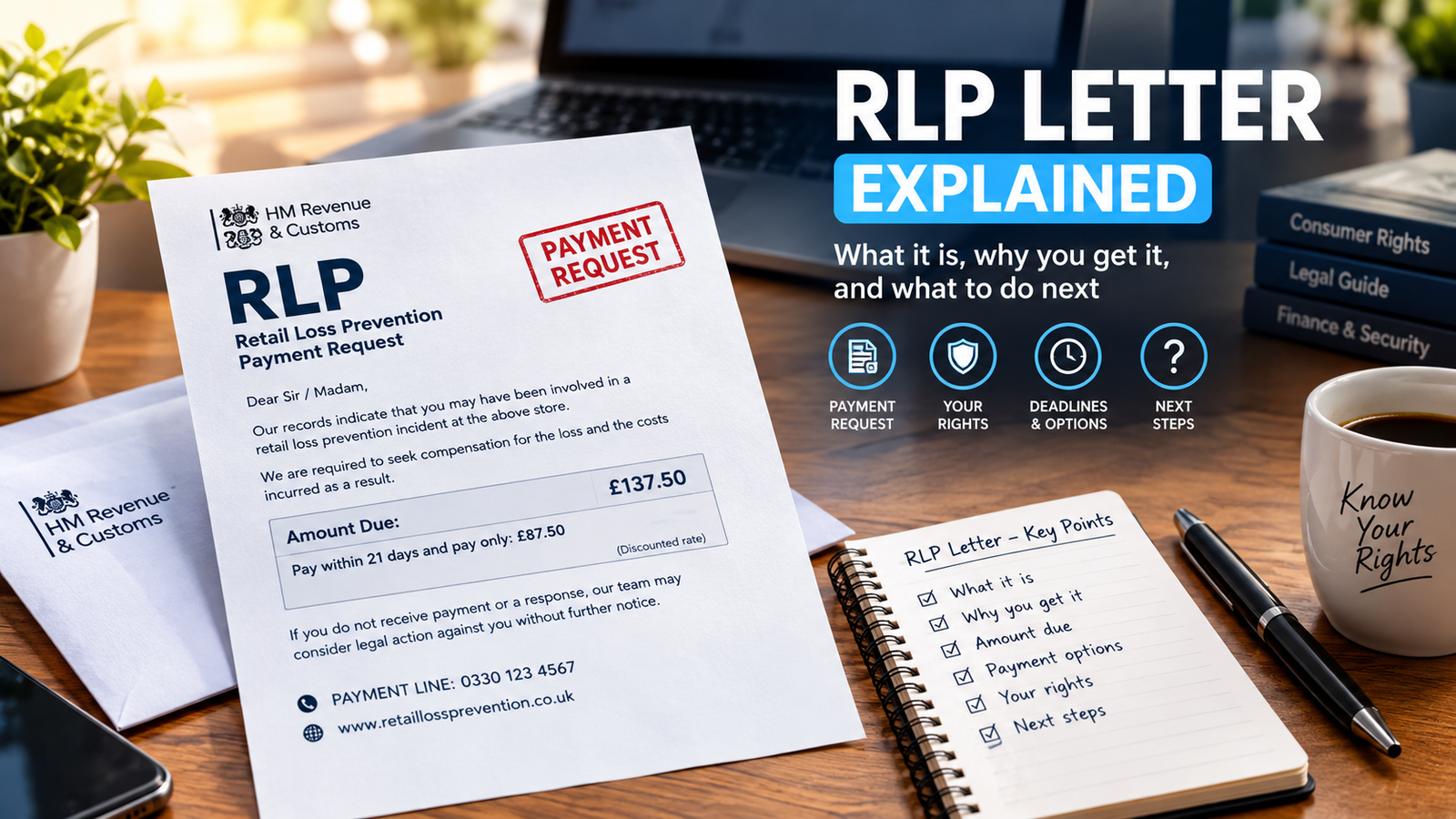
An RLP letter is most commonly associated in the UK with Retail Loss Prevention Limited (RLP) and its civil-recovery work for retailers and other businesses. People generally search for the term after receiving correspondence concerning an alleged shoplifting, theft, fraud, or another incident that a retailer says caused it a financial loss. The letter can request compensation and may mention further action if the matter is not resolved.
The important point is that an RLP letter is not automatically a criminal fine, criminal conviction, or court judgment. It is generally correspondence concerning a civil claim. Whether money is actually owed depends on the facts, evidence, applicable law, and the retailer’s legal entitlement to recover the amount claimed. Citizens Advice explains that a business seeking compensation for an alleged loss may bring civil action and would need to establish its entitlement to compensation if the matter reaches court.
Quick Information Table
| Feature | Details |
|---|---|
| Term | RLP letter |
| Common meaning in UK retail | Retail Loss Prevention letter |
| RLP stands for | Retail Loss Prevention |
| Organization commonly associated | Retail Loss Prevention Limited |
| Main purpose | Civil recovery correspondence |
| Common context | Alleged shoplifting, theft, fraud or retail loss |
| Type of matter | Civil, rather than automatically criminal |
| Is it a court judgment? | No |
| Is it automatically a criminal fine? | No |
| Can a retailer potentially pursue court action? | Yes, depending on the circumstances |
| Company incorporation | 18 June 2003 |
| Company status | Active private limited company |
| Company number | 04802733 |
| Registered office | International House, 10 Beaufort Court, Admirals Way, London E14 9XL |
| Current director listed publicly | Jacqueline Ann Lambert |
| Current major controlling person listed publicly | Jacqueline Ann Lambert |
| Geographic context | Primarily UK retail civil recovery |
| Important distinction | An RLP demand is different from a formal court judgment |
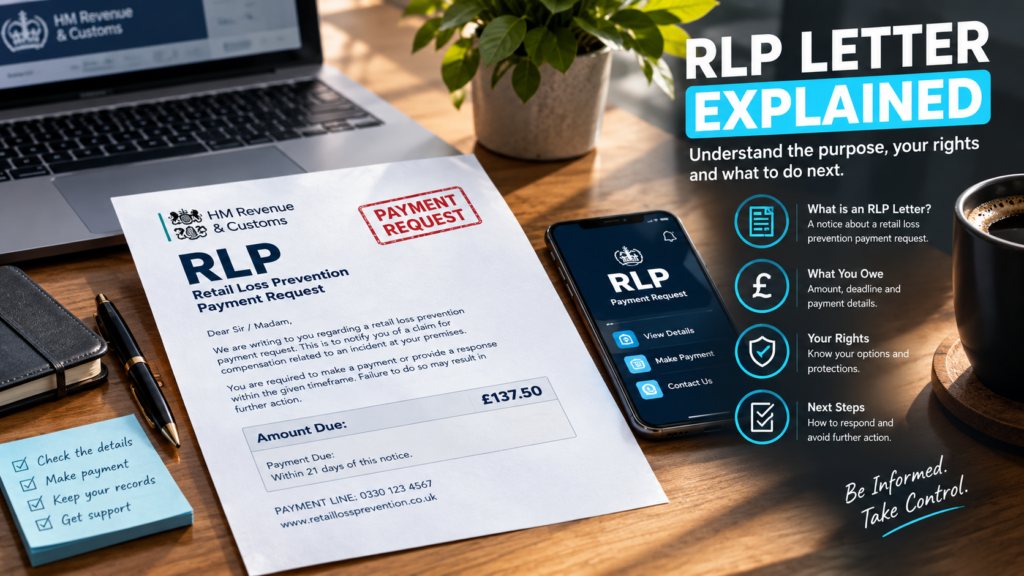
What Is an RLP Letter?
An RLP letter generally refers to correspondence sent by Retail Loss Prevention Limited in connection with a civil recovery claim made for a retailer or other business.
The purpose is generally to seek compensation for a loss that the retailer says resulted from an alleged incident. The first correspondence may identify the date and location of the incident, the business involved, the basis of the alleged civil liability, the amount being requested, and available ways of dealing with the matter.
The abbreviation “RLP” can have other meanings in unrelated fields, so the sender should always be checked. If the document actually comes from Retail Loss Prevention Limited and concerns a UK retail incident, the civil-recovery meaning is the relevant one.
What Does RLP Stand For?
In the retail context, RLP stands for Retail Loss Prevention.
Retail Loss Prevention Limited is a UK private company that handles civil-recovery matters for business clients. Public company records show that it was incorporated on 18 June 2003 under company number 04802733 and is currently listed as an active private limited company.
The company’s current registered office is listed at International House, 10 Beaufort Court, Admirals Way, London, E14 9XL. Public records also list Jacqueline Ann Lambert as an active director and as the person with significant control holding at least 75% of shares and voting rights.
The company also appears on the UK Information Commissioner’s Office register as a data controller, with a registration dating back to September 2003.
Why Might Someone Receive an RLP Letter?
An RLP letter may follow an incident in which a retailer believes it has suffered a financial loss.
Common situations discussed in connection with these letters include:
- Alleged shoplifting
- Alleged theft of merchandise
- Employee theft
- Fraud-related incidents
- Damage or other conduct that a business says caused financial loss
- Other incidents for which a retailer believes civil compensation may be appropriate
Citizens Advice confirms that a business can potentially seek civil compensation after allegations such as shoplifting or employee theft. It also explains that civil action can occur separately from criminal proceedings.
This means that an RLP letter may arrive even where the recipient believed that an incident at a store had already ended.
What Information Is Usually in an RLP Letter?
An RLP letter should provide enough information for the recipient to understand what claim is being made.
Typical information may include:
The Retailer
The correspondence normally identifies the business on whose behalf the claim is being pursued.
Date and Location
The letter may identify when and where the alleged incident took place.
Description of the Allegation
The correspondence should explain the circumstances that the retailer says resulted in a loss.
Amount Claimed
The letter normally states the amount the business is seeking to recover.
Basis of the Claim
The recipient may be given an explanation of why the business believes civil liability exists.
Reference or Case Number
Correspondence can contain a reference number used to identify the particular matter.
Options for Responding
The letter may explain available payment or communication options and provide information about what the recipient can do next.
Reading the entire document is therefore more useful than concentrating only on the amount requested.
Is an RLP Letter a Fine?
No. An RLP civil-recovery demand should not automatically be described as a criminal fine.
A criminal fine is a punishment imposed through the criminal justice system. An RLP demand is generally connected with a civil claim for compensation.
This distinction matters because receiving the letter does not itself mean that a court has convicted the recipient or ordered them to pay the stated amount.
A retailer can potentially pursue civil compensation separately from a criminal process. Citizens Advice specifically explains that businesses may seek compensation through civil action and that this can occur instead of, or alongside, criminal action.
Is an RLP Letter the Same as a Court Judgment?
No.
There is a significant difference between:
- An RLP civil-recovery letter
- A formal court claim
- A court judgment
An RLP letter is correspondence concerning a claim. A court judgment is a decision formally issued by a court.
If a business eventually starts court proceedings, the recipient will receive formal court documents and must follow the instructions and deadlines contained in those documents.
A County Court Judgment, or CCJ, is created only after the court has formally entered judgment. Government guidance explains that a CCJ is a formal court decision that someone owes money.
Therefore, receiving an RLP letter by itself does not create a CCJ.
Does an RLP Letter Create a Criminal Record?
The letter itself is not a criminal conviction.
Civil recovery and criminal proceedings are separate legal processes. A particular incident can potentially involve both, but one does not automatically become the other.
For example, a retailer may pursue a civil claim for compensation while police or prosecutors separately deal with an alleged criminal offence.
This is why the exact circumstances of the incident matter.
What Can a Retailer Claim?
The amount requested in a civil recovery letter can include more than the value of merchandise, depending on the legal basis of the claim and the circumstances.
Citizens Advice explains that a business may seek compensation for losses such as:
- The value of cash or goods allegedly stolen
- Staff investigation costs
- Other investigation expenses
- Administration costs
- Legal costs
- Certain security-related costs
However, Citizens Advice also notes that costs such as staff investigation, administration, or security expenses must be supported and reasonably claimable; a business cannot simply assume that a fixed amount is automatically recoverable.
This is an important distinction when examining an RLP demand.
Does the Amount on the Letter Automatically Have to Be Paid?
The amount written in a demand letter is not automatically equivalent to a court-awarded debt.
A demand represents what the claimant says is owed. If the matter is disputed and proceeds to court, the claimant would need to establish its legal entitlement to compensation.
Citizens Advice explains that if a business takes civil action, it must prove in court that it is entitled to the compensation it seeks.
This does not mean that every demand is invalid or that every recipient should simply refuse payment. It means that the legal status of a demand should be distinguished from the status of a court judgment.
What Should You Check When You Receive an RLP Letter?
If you receive an RLP letter, the first step is to understand exactly what the document says.
Check the Sender
Confirm the full company name and contact details.
Check the Retailer
Identify which retailer or business is said to have suffered the loss.
Check the Incident
Review the date, location, and description of the alleged incident.
Check the Amount
Look at the total amount requested and any explanation of how it was calculated.
Check the Deadline
Look for any date by which the sender asks for a response or payment.
Check Whether It Is Court Documentation
Do not confuse a demand letter with formal court paperwork.
Keep Copies
Keep the original letter, envelopes, emails, receipts, and any other relevant records.
These basic steps can help establish exactly what type of correspondence has been received and what stage the matter is at.
What If the Claim Is Incorrect?
A recipient who believes that an RLP claim is inaccurate can communicate their position.
Possible issues may include disagreement about:
- Whether the alleged incident occurred
- Who was involved
- What happened
- The amount of loss
- Whether particular costs are recoverable
- Whether the claimant has sufficient evidence
- Whether the recipient is legally liable
The appropriate response depends heavily on the facts.
Because civil recovery is a legal matter, people who are unsure about their position may want independent advice from a solicitor or an appropriate consumer-advice service.
What Happens If the Matter Goes to Court?
An RLP demand can potentially be followed by civil proceedings.
However, a statement that court action could occur is different from an actual court claim.
If formal court papers arrive, they should be treated differently from ordinary correspondence. Government guidance states that a person who receives a court claim must respond by the deadline stated in the court paperwork.
Ignoring formal court documents can result in judgment being entered.
If a CCJ is ultimately issued, the consequences are different from those of an initial RLP letter. Government guidance states that a CCJ normally remains on the Register of Judgments, Orders and Fines for six years. If the judgment is paid in full within one month, it can be removed from the register under the relevant procedure.
RLP Letter vs. CCJ
The difference can be summarized simply:
| RLP Letter | CCJ |
|---|---|
| Civil recovery correspondence | Formal court judgment |
| Sent by or on behalf of a claimant | Issued by a court |
| Requests or seeks payment | Formally determines liability |
| Not itself a criminal conviction | Not itself a criminal conviction |
| Not automatically a CCJ | Is a court judgment |
| Can precede legal proceedings | Results from court proceedings |
| Does not itself appear as a CCJ | Can remain on the judgment register |
Understanding this distinction prevents unnecessary confusion about the legal status of an RLP letter.
Can an RLP Letter Affect Your Credit Record?
An initial RLP demand is different from a court judgment.
Government guidance states that a CCJ or High Court judgment is recorded on the Register of Judgments, Orders and Fines for six years, subject to the rules concerning payment within one month.
Therefore, it is important not to describe an RLP letter itself as a CCJ.
If court proceedings occur and a judgment is entered, the situation is different and the recipient should follow the court’s instructions.
Civil Recovery and Criminal Proceedings
Civil and criminal procedures can exist separately.
A criminal case is concerned with whether an offence was committed and the appropriate criminal consequences. A civil claim is concerned with liability and compensation.
Citizens Advice specifically notes that a business may seek civil compensation even when criminal action is also being considered or has taken place.
This separation explains why someone might encounter both police-related correspondence and a separate civil-recovery letter following the same underlying incident.
Important Differences Between England, Wales and Scotland
The exact court process depends on where the matter is being handled.
In England and Wales, money claims can result in County Court proceedings and potentially a CCJ. Government guidance provides specific information about County Court judgments and their effect on the judgment register.
Scotland uses a different court system and terminology. Citizens Advice Scotland explains that civil recovery for alleged theft can involve the Sheriff Court, while Scottish money judgments are referred to as decrees rather than CCJs.
This geographical distinction is important when researching an RLP letter because advice that applies to England and Wales should not automatically be treated as Scottish procedure.
History of Retail Loss Prevention Limited
Retail Loss Prevention Limited has a documented corporate history dating back to 2003.
Companies House records show that the company was incorporated on 18 June 2003. Its previous company name was Goldcert Limited, which it used between June and October 2003. The company is currently listed as active.
Its public filing history shows continuing corporate filings, including accounts and confirmation statements. The registered office changed in November 2025 from Berkeley Square in London to its current address at International House, 10 Beaufort Court, Admirals Way.
This provides a verifiable corporate background for the organization commonly associated with the term RLP letter.
Recent Corporate Information
The company’s recent public filings show that it remains active in 2026.
A January 2026 confirmation statement was filed with updates, and records show changes involving its director and secretary during January 2026.
The company is therefore not simply an informal name used for retail correspondence; it is a registered UK private limited company with an ongoing corporate record.
Common Misunderstandings About RLP Letters
“An RLP Letter Is a Court Order”
It is not automatically a court order. A demand letter and a court judgment are different documents.
“The Amount on the Letter Is Automatically a Court-Ordered Debt”
It is a claimed amount, not automatically a sum awarded by a court.
“Receiving the Letter Means I Have a Criminal Conviction”
No. The letter itself does not create a criminal conviction.
“An RLP Letter and a CCJ Are the Same Thing”
They are not. A CCJ is a formal judgment issued by a court.
“Every RLP Letter Has the Same Legal Meaning Everywhere”
No. RLP can have other meanings outside the UK retail context, so the sender and circumstances should always be checked.
How to Approach an RLP Letter Responsibly
The most useful approach is to avoid both extremes: do not automatically assume that the letter is a court judgment, but also do not automatically assume that it has no legal significance.
Instead:
- Read the complete document.
- Identify the sender and retailer.
- Check the alleged incident and date.
- Examine the amount claimed.
- Look for the response deadline.
- Preserve relevant evidence and correspondence.
- Distinguish ordinary correspondence from formal court documents.
- Seek independent legal or consumer advice if the circumstances are disputed or unclear.
- Treat any genuine court paperwork as a separate and more formal stage.
This approach focuses on the actual contents of the document rather than assumptions about what the abbreviation means.
Frequently Asked Questions About RLP Letter
What does RLP letter mean?
In the UK retail context, an RLP letter generally means correspondence from Retail Loss Prevention Limited concerning a civil recovery claim made for a retailer or business.
Is an RLP letter a fine?
No. It is generally a civil recovery demand rather than a criminal fine.
Is an RLP letter a court judgment?
No. An RLP letter is not automatically a court judgment or CCJ.
Why would a retailer send an RLP letter?
A retailer may refer an alleged incident to a civil-recovery service when it believes the incident caused a financial loss and it wants to seek compensation.
Can an RLP matter go to court?
A civil recovery dispute can potentially progress to court. If formal court proceedings are started, the recipient should follow the instructions and deadlines in the official court documents.
Does an RLP letter create a criminal record?
The letter itself does not create a criminal record. Civil recovery and criminal proceedings are separate processes.
Can an RLP claim be disputed?
A recipient can dispute a claim if they believe the facts, liability, or amount claimed are incorrect. The appropriate response depends on the individual circumstances.
What is a CCJ?
A County Court Judgment is a formal court decision that someone owes money. Government guidance says a CCJ normally remains on the judgment register for six years, subject to the rules concerning payment within one month.
Conclusion
An RLP letter most commonly refers in the UK to civil-recovery correspondence associated with Retail Loss Prevention Limited. It is generally sent on behalf of a retailer or other business after an alleged incident that the business says caused financial loss. The letter may identify the incident, retailer, claimed liability, amount requested, and available ways of responding.
The most important distinction is that an RLP letter is not automatically a criminal fine, criminal conviction, CCJ, or court judgment. It is a civil claim or demand, and the legal position depends on the individual facts and evidence. Citizens Advice confirms that businesses can pursue civil compensation and that they must establish their entitlement if the matter reaches court.
Retail Loss Prevention Limited itself has a documented corporate history. It was incorporated in 2003 and remains an active UK private limited company, with recent corporate filings continuing into 2026.
Anyone receiving an RLP letter should therefore read it carefully, establish exactly what is being claimed, distinguish it from formal court paperwork, preserve relevant records, and obtain appropriate independent advice where the facts or legal position are disputed or unclear.